What Is Virtual Bookkeeping and How It Works: An In-Depth Guide



Summary:
Virtual bookkeeping has changed how businesses manage their finances. Instead of relying on in-house staff or manual processes, companies can now access skilled bookkeepers, secure systems, and real-time reporting remotely. This guide explains what virtual bookkeeping is, how it works, and how businesses can use it to improve accuracy, control costs, and scale efficiently; without compromising security or compliance.
Bookkeeping has changed significantly over the last decade. Businesses no longer need an on-site team to manage financial records, track transactions, or maintain compliance. Instead, many organizations are turning to virtual bookkeeping as a more flexible and efficient alternative.
This shift is not just about convenience. It reflects how businesses operate today: digitally, remotely, and with tighter control over costs. Understanding what virtual bookkeeping is, how it works, and when it makes sense is now essential for business owners and finance leaders.
This guide breaks down what is virtual bookkeeping, how a virtual bookkeeper works, and why this model continues to gain traction across industries.
What Is Virtual Bookkeeping?
Virtual bookkeeping refers to managing a company’s bookkeeping functions remotely using cloud-based accounting tools. Instead of hiring an in-house bookkeeper, businesses work with a virtual bookkeeper who handles financial records off-site.
Let us first clarify what is a virtual bookkeeper. It is a trained accounting professional who performs the same core tasks as a traditional bookkeeper but operates remotely. Communication, document sharing, and reporting are handled through secure digital platforms.
In simple terms, virtual book keeping delivers the same bookkeeping outcomes without requiring physical presence. This model supports businesses that want flexibility, scalability, and consistent financial visibility.

Ready to simplify bookkeeping while improving accuracy and security? Virtual bookkeeping is a proven solution. Let us deep dive into it together.
Book a no-obligation call!
Click Here!How Virtual Bookkeeping Works
The process behind bookkeeping virtual services is structured and standardized. While tools and workflows may differ slightly, most virtual bookkeeping engagements follow a similar model.
First, the business provides access to its accounting software, bank feeds, and financial documents. Secure cloud platforms are used to protect sensitive data.
Next, the virtual book keeper records transactions, reconciles accounts, and maintains the general ledger. Regular check-ins ensure accuracy and alignment with business needs.
Finally, reports are shared on a scheduled basis. These may include monthly financial statements, cash flow summaries, or management dashboards.
This remote setup allows businesses to stay informed without managing day-to-day bookkeeping tasks internally.
What Does a Virtual Bookkeeper Do?
To fully understand the value of this model, it helps to answer a common question: what does a virtual bookkeeper do?
A virtual bookkeeper typically handles:
- Recording daily financial transactions
- Reconciling bank and credit card accounts
- Managing accounts payable and receivable
- Preparing monthly financial statements
- Supporting tax readiness and audits
In many cases, a virtual bookkeeping business also provides process improvements and automation support. This ensures books stay accurate as transaction volume grows.
While the work happens remotely, the level of accountability and precision mirrors that of an in-house function.
Why Businesses Are Adopting Virtual Bookkeeping
Businesses are increasingly turning to virtual bookkeeping. In fact, recent market data shows that the global virtual bookkeeping services market was valued at about USD 4.5 billion in 2024 and continues to expand as more companies embrace remote financial operations.
Another study shows that 65 % of companies outsource bookkeeping and related financial services, reflecting a broader trend toward remote and outsourced finance work.
Cost efficiency plays a role, but it is not the only factor. Businesses gain access to experienced professionals without long-term hiring commitments. This is especially valuable during periods of growth or seasonal fluctuation.
In addition, virtual bookkeeping provides continuity. This implies work does not stop due to turnover, absences, or office constraints. Processes remain consistent, and financial data stays current.
For many organizations, this model offers stability without added complexity.
Virtual Bookkeeping vs Traditional Bookkeeping
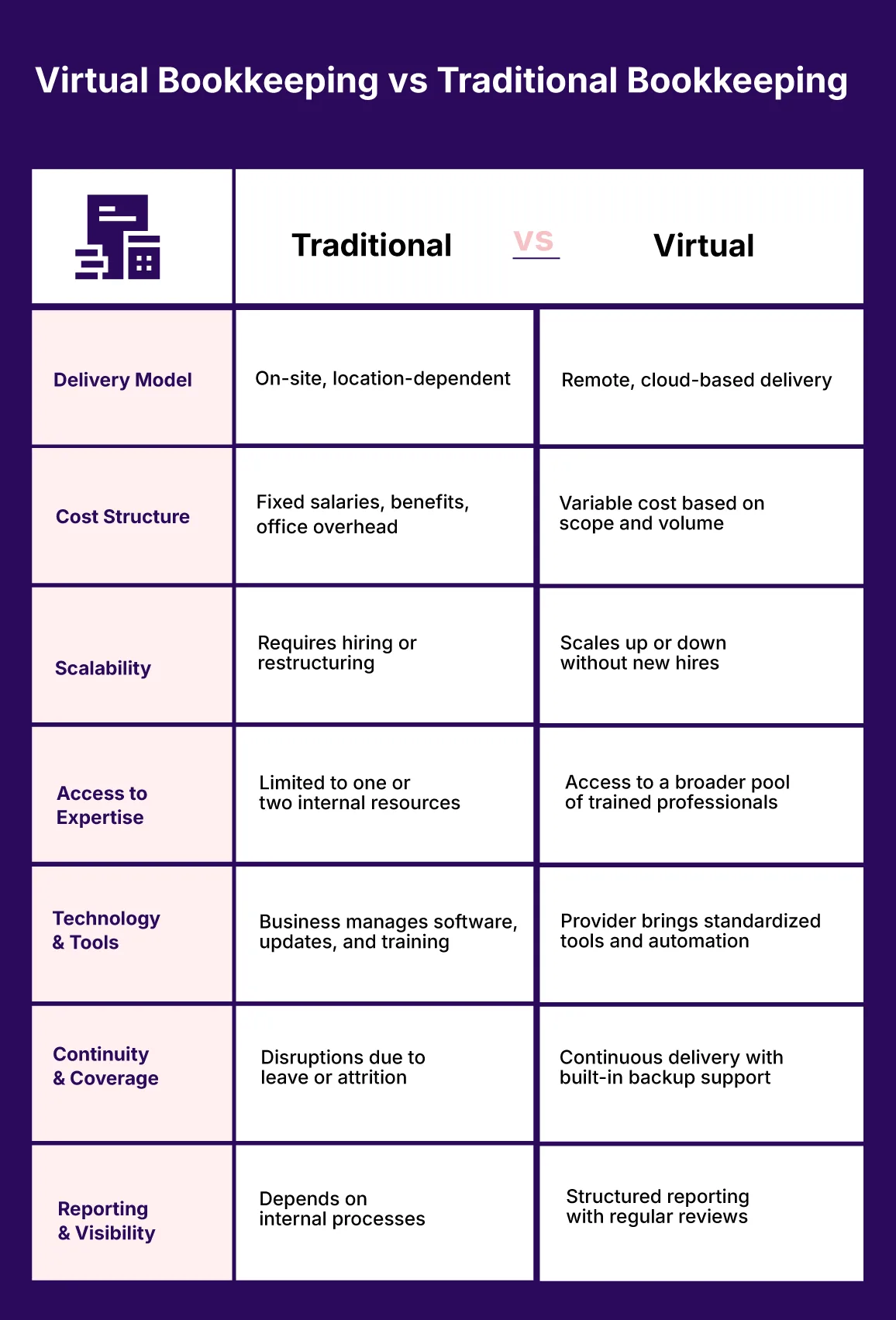
The core difference between traditional and virtual bookkeeping lies in delivery, not capability.
Traditional bookkeeping requires physical presence and fixed staffing. This often limits flexibility and increases overhead. By contrast, virtual book keeping relies on cloud systems and remote expertise. Businesses pay for what they need and scale support as required.
Both models deliver accurate books. However, virtual bookkeeping aligns better with businesses seeking efficiency and adaptability. Here’s a more detailed comparison of the two.
Is Virtual Bookkeeping Secure?
Security is often the first concern when businesses consider virtual bookkeeping, and rightly so. Reputable providers operate on secure cloud platforms with encrypted data transfer, role-based access, and detailed audit trails.
Unlike manual or spreadsheet-driven systems, cloud-based workflows reduce human error and unauthorized access. Regular backups and monitoring ensure data integrity at all times. When implemented correctly, virtual bookkeeping can be more secure than traditional setups.
How to Be a Virtual Bookkeeper
Many professionals are exploring remote finance roles, which has increased interest in how to be a virtual bookkeeper. The foundation typically includes bookkeeping or accounting training, followed by hands-on experience with cloud accounting software.
Strong communication skills are equally important, as client interaction happens remotely. Many professionals choose to work with an established virtual bookkeeping business, which provides structure, tools, and steady work instead of operating independently.
When Virtual Bookkeeping Makes Sense
Virtual bookkeeping becomes a strong fit when transaction volumes increase or internal teams feel stretched. It is especially useful for businesses that want consistent books without expanding headcount.
Companies with remote teams, multiple locations, or fast growth benefit from standardized processes and real-time visibility. At this stage, virtual bookkeeping shifts from a convenience to an operational necessity. This is when outsourcing virtual bookkeeping makes the most sense.
Final Thoughts
Virtual bookkeeping is no longer an alternative model. It is becoming the standard for businesses that value accuracy, flexibility, and scalability. By removing location constraints and fixed overhead, it allows companies to maintain strong financial control while staying agile.
Providers like QX offer structured bookkeeping services that combine trained talent, secure systems, and standardized workflows. This helps businesses move beyond basic recordkeeping toward a more reliable and scalable finance function.
For organizations looking to modernize their bookkeeping without adding complexity, virtual bookkeeping with the right partner offers a clear path forward.
Want to take this conversation ahead? Let us connect!
FAQs
1. What is virtual bookkeeping and how does it work?
Virtual bookkeeping is the remote management of day-to-day financial records using cloud-based accounting systems. A virtual bookkeeper handles transactions, reconciliations, reporting, and compliance without being physically present. Data is shared securely, and businesses receive real-time visibility into their finances.
2. What does a virtual bookkeeper do on a daily basis?
A virtual bookkeeper manages transaction categorization, bank and credit card reconciliations, accounts payable and receivable, payroll coordination, and monthly reporting. They also ensure records stay audit-ready and aligned with accounting standards. The scope can scale based on business needs.
3. Is virtual bookkeeping secure for sensitive financial data?
Yes, when delivered through the right provider. Secure virtual bookkeeping relies on encryption, role-based access, audit trails, and compliance frameworks like SOC 2. Providers with strong controls often offer higher security than fragmented in-house setups.
4. When does virtual bookkeeping make the most sense for a business?
Virtual bookkeeping is ideal for growing businesses, startups, and firms that want accurate financials without building a full in-house team. It is also useful during expansion, seasonal volume spikes, or when internal teams need to focus on higher-value work.
5. How is virtual bookkeeping different from traditional bookkeeping?
Traditional bookkeeping depends on physical presence and manual processes. Virtual bookkeeping uses cloud systems, automation, and standardized workflows. This results in faster closes, better accuracy, easier collaboration, and lower overhead costs.
Enquire now

Cora Vollmar
With over 20 years of experience in accounting, talent strategy, operations, and business development, Cora Vollmar helps CPA firms solve capacity challenges and build scalable growth strategies. She is an expert in senior-level accounting and CPA recruiting, with a proven track record of helping firms develop talent pipelines, recruit leadership professionals, and address the ongoing accounting talent shortage.
Through strong relationships with State CPA Societies, accounting alliances, and industry organizations, Cora brings valuable insight into firm growth, talent trends, and the future of the profession. At QX Accounting Services, she helps firms leverage global talent, managed services, and workforce strategies to build sustainable capacity and support long-term growth.
Unauthorized copying or plagiarism of our content is a violation of intellectual property rights. We take such matters seriously and will pursue legal action to protect our original work. Anyone found engaging in such activities will be held accountable under applicable laws.
Don't forget to share this post!
Our Latest Insights


Marketing Services
Outsourced Marketing Services vs In-House Team for CPA Firms...
23 September 2026

Marketing Services
How to Choose an Outsourced Marketing Partner for Your CPA F...
21 September 2026

Let’s Work Together
Explore outsourcing solutions, request a no-obligation trial or discuss your practice’s needs with our expert consultants.
 Book a Virtual Meeting
  Get Your ROI Estimate