Fixed-Cost vs Hourly Bookkeeping Outsourcing 2026



Bookkeeping outsourcing can help CPA firms control capacity, protect turnaround times, and keep client work moving without hiring for every seasonal spike. Firms evaluating outsource bookkeeping services should consider not only what support they need, but also how the engagement should be priced.
The real decision is not simply whether to outsource. It is how to price the engagement: fixed cost, hourly, dedicated team, or a hybrid model.
This guide compares fixed-cost vs hourly bookkeeping outsourcing based on predictability, flexibility, scope control, operating risk, and long-term value.
The right bookkeeping outsourcing model is not the one with the lowest rate. It is the one that fits how the work actually moves through the firm.
Sagar Ahuja, CEO, QX Accounting Services
- Which Bookkeeping Pricing Model Fits Your CPA Firm?
- The Practical Difference Between Fixed-Cost and Hourly Outsourcing
- Fixed-Fee Bookkeeping Outsourcing Creates Predictability
- Hourly Bookkeeping Outsourcing Supports Uncertain Work
- Cost Is Only One Part of the Outsourcing Decision
- Compliance, Documentation, and Client Expectations Matter
- Dedicated Bookkeeping Team Pricing Can Support Growth
- How to Choose Between Fixed-Cost and Hourly Support?
- Common Pricing Mistakes CPA Firms Should Avoid
- How CPA Firms Can Evaluate the ROI of Each Model ?
- Conclusion
- FAQs
Which Bookkeeping Pricing Model Fits Your CPA Firm?
The best pricing model depends on how predictable the work is, how mature the firm’s workflows are, and how much variability exists across its client base.
Fixed-fee bookkeeping outsourcing generally works well when monthly tasks, transaction volume, reporting cadence, and responsibilities are clearly defined.
Hourly bookkeeping outsourcing is often better when the work is irregular, cleanup-heavy, advisory-adjacent, or still being scoped.
For CPA firms in the United States, the decision should also account for client expectations, documentation requirements, and the firm’s own billing strategy.
If a firm sells monthly client accounting services, a fixed outsourcing cost can make margins easier to forecast. If the firm handles catch-up bookkeeping, project work, or clients with incomplete records, hourly support may reduce the risk of underpricing.
The right model is not necessarily the one with the lowest rate. It is the one that fits how the work actually moves through the firm.
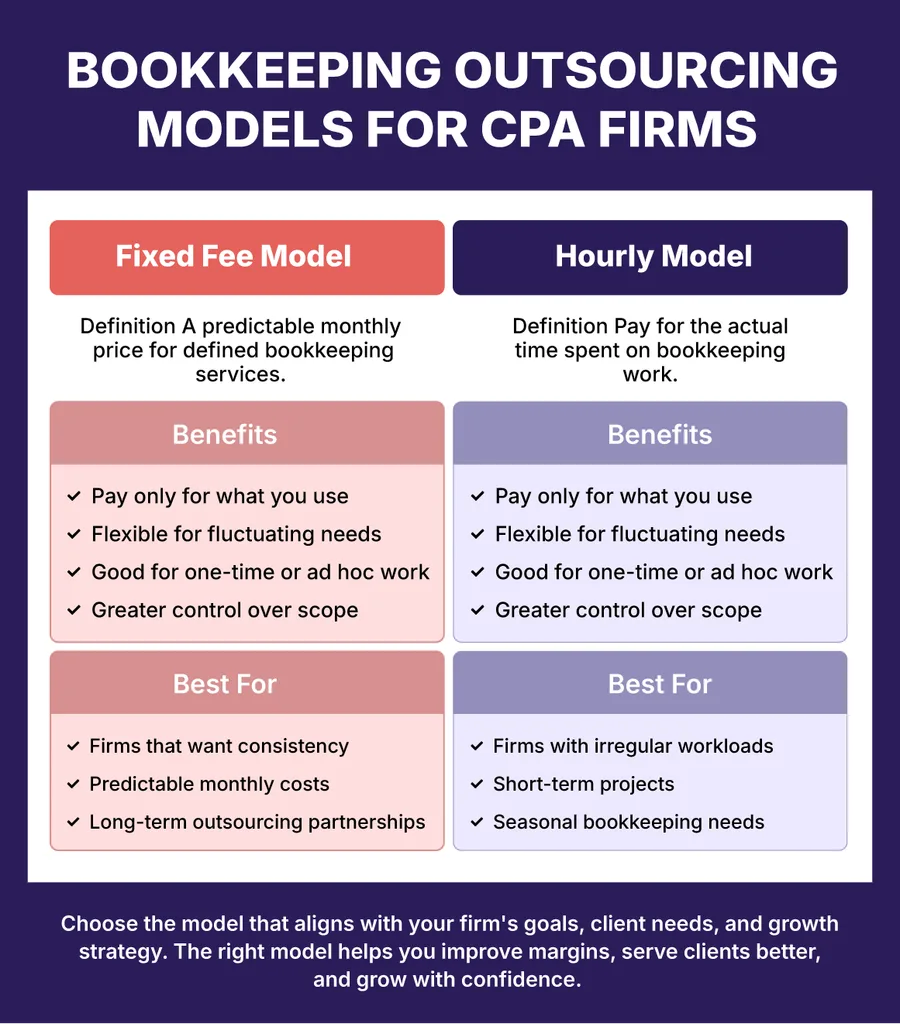
The Practical Difference Between Fixed-Cost and Hourly Outsourcing
Fixed-cost outsourcing means the provider charges a set amount for a defined package of work. That package may include monthly bookkeeping, bank and credit card reconciliations, accounts payable support, management reporting, or controller review, depending on the engagement.
The cost is agreed upon in advance, allowing the firm to plan around a predictable monthly expense.
Hourly outsourcing charges for the time spent completing the work. This gives the CPA firm greater flexibility when workload changes, but it can make outsourced bookkeeping costs harder to forecast.
If a client’s records are disorganized, transactions require additional research, or communication delays slow the work, billable hours can increase.
Neither model is automatically better. The right choice comes from matching the pricing structure to the underlying work pattern.
Bookkeeping Outsourcing Pricing at a Glance
- Fixed cost: Best for recurring, clearly scoped monthly bookkeeping.
- Hourly: Best for variable, uncertain, or cleanup-heavy work.
- Hybrid: Best when a firm needs a stable monthly base plus flexibility for out-of-scope tasks.
- Dedicated team: Best when a firm needs consistent staffing, process familiarity, and scalable support across multiple clients.
For a broader comparison of available structures, see the guide to pricing models used by bookkeeping outsourcing companies. The guide covers hourly, fixed-fee, project-based, dedicated-team, and value-based arrangements.
Fixed-Fee Bookkeeping Outsourcing Creates Predictability
Fixed-fee bookkeeping outsourcing gives firms a clear monthly number. That predictability matters when a CPA firm has already priced its client package and needs to preserve margin.
If the firm knows what it charges the client and what it pays the outsourcing partner, profitability becomes easier to track.
This model also encourages better process design. Because the provider and the firm agree on scope upfront, both sides must define:
- What is included
- What is excluded
- Which software will be used
- When source documents must be available
- When deliverables are due
- How exceptions will be handled
- What triggers a scope or price change
Clear scope reduces confusion and prevents recurring bookkeeping from turning into a collection of one-off requests. Fixed-fee arrangements are particularly useful for clients with steady transaction volume and repeatable monthly workflows.
For example, a professional services client with predictable bank activity, limited credit card usage, and standard monthly reporting may be a strong fit. The bookkeeping team can follow a consistent checklist, ask fewer recurring questions, and maintain a reliable close schedule.
The main risk is scope creep. If the client adds payroll coordination, sales tax support, inventory tracking, class coding, or additional reporting without a corresponding pricing update, the fixed fee may no longer reflect the actual delivery effort.
That is why fixed-fee engagements require a structured onboarding process and a clear change-order mechanism.
Hourly Bookkeeping Outsourcing Supports Uncertain Work
Hourly bookkeeping outsourcing gives firms room to manage work that is difficult to estimate.
This is common when a new client arrives with:
- Months of unreconciled accounts
- Missing bank or credit card statements
- Mixed personal and business expenses
- Inconsistent bookkeeping practices
- Unclear opening balances
- Multiple software platforms
- Historical classification issues
In these situations, a fixed quote may look simple at the beginning but become risky once the actual condition of the books is understood.
Hourly pricing is also useful for advisory support and special projects. If the outsourced team is helping with cleanup before tax preparation, converting records to a new platform, reviewing historical classifications, or supporting year-end adjustments, the scope may evolve as the work progresses.
Billing by time can prevent the provider from inflating a fixed quote to cover unknown risks.
For the CPA firm, the trade-off is budget uncertainty. If time tracking is not transparent, the firm may struggle to explain the cost internally or pass it through to the client.
Hourly engagements should therefore include:
- Approved time budgets
- Time summaries by task
- Clear task notes
- Spending thresholds
- Checkpoints before additional hours are incurred
- Approval rules for out-of-scope work
A practical approach is to use hourly pricing during discovery and cleanup, then move the client to a fixed monthly model once the books and workflow are stable.
This limits early-stage pricing risk while creating longer-term predictability.
Cost Is Only One Part of the Outsourcing Decision
Outsourced bookkeeping pricing should not be evaluated on rate alone.
A lower hourly rate may still produce a higher total operating cost if the team requires excessive review, misses details, or does not understand the firm’s workflow.
Similarly, a fixed monthly fee may appear higher initially but create stronger value if it includes trained staff, consistent reporting, quality review, process continuity, and responsive communication.
CPA firms comparing accounting and bookkeeping outsourcing costs should assess the full operating impact rather than looking only at the quoted rate. QX’s pricing resource compares in-house staffing costs with outsourced delivery and outlines several engagement structures, including dedicated, managed, transaction-based, and outcome-based models.
Important evaluation criteria include:
Scope Clarity
Does the proposal clearly define included tasks, excluded tasks, reporting frequency, software responsibilities, client responsibilities, and communication channels?
Quality Control
Is there a review process before the work is returned to the CPA firm or delivered to the client?
Turnaround Time
Can the provider support month-end deadlines, tax-season pressures, and client-specific reporting requirements?
Accounting Knowledge
Does the delivery team understand the firm’s accounting standards, documentation requirements, and US GAAP expectations where applicable?
Scalability
Can the provider support additional clients without requiring the firm to restart onboarding and training each time volume increases?
Data Security and Access Management
Are system permissions, document-sharing procedures, access reviews, and confidentiality controls aligned with the firm’s risk expectations?
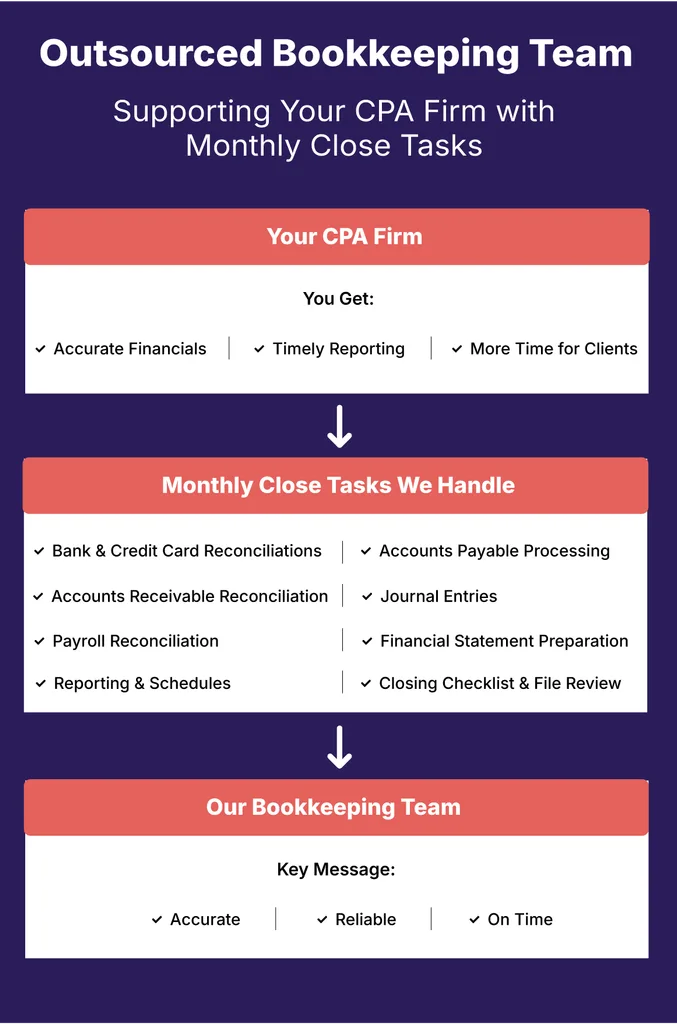
CPA firms can also review QXAS’s bookkeeping outsourcing services to understand the typical scope of outsourced delivery, including bank reconciliations, credit card reconciliations, accounts receivable, accounts payable, payroll support, reporting, and query management.
Compliance, Documentation, and Client Expectations Matter
Bookkeeping is not simply data entry. For CPA firms, bookkeeping output supports tax preparation, advisory conversations, financial reporting, cash flow planning, and management decisions. Pricing therefore needs to support the required level of accuracy, documentation, and review.
The IRS explains in Publication 583 that proper records help businesses monitor progress, prepare financial statements, identify sources of receipts, track deductible expenses, prepare tax returns, and support items reported on tax returns.
For financial reporting, the FASB Accounting Standards Codification is the source of authoritative generally accepted accounting principles for nongovernmental entities, other than standards issued by the SEC.
Not every bookkeeping engagement requires GAAP-basis reporting. However, CPA firms should understand when the client’s reporting needs require stronger accounting oversight or additional review.
The engagement structure also matters. AICPA-endorsed engagement-letter guidance explains that an engagement letter should address the scope of service, each party’s responsibilities, expected deliverables, timing, fees, and services that are excluded. Clear engagement letters can also help firms manage scope creep and reduce misunderstandings.
In an outsourced model, that principle applies to two relationships:
- The relationship between the CPA firm and its client
- The relationship between the CPA firm and its outsourcing provider
Good documentation should answer practical questions such as:
- Who collects bank statements, receipts, invoices, and payroll reports?
- Who follows up on uncategorized transactions?
- What happens when client records are incomplete?
- Which tasks are included in the monthly fee?
- Which tasks are billed hourly or quoted separately?
- Who answers client-specific accounting questions?
- Who performs the final review before reports are delivered?
- What event triggers a scope review or pricing adjustment?
Dedicated Bookkeeping Team Pricing Can Support Growth
Dedicated bookkeeping team pricing is a separate consideration from fixed versus hourly billing. Instead of purchasing isolated tasks, the CPA firm gains access to a consistent team that becomes familiar with its processes, client preferences, software stack, documentation standards, and review style.
This can be useful for firms building a client accounting services practice or managing recurring bookkeeping work across numerous clients.
A dedicated team may be priced as:
- A monthly capacity arrangement
- A defined full-time-equivalent model
- A bundled service package
- A customized staffing model
- A managed delivery arrangement
The main benefit is continuity. When the same professionals work on the same client group each month, they can identify unusual activity faster, reduce repeated questions, and follow firm-specific workflows more consistently.
A dedicated model may also reduce the hidden cost of continual retraining. A firm that sends work to a different preparer every month may spend more partner or manager time reviewing, correcting, and re-explaining expectations.
A dedicated team is not automatically cheaper, but it may create stronger operating value when volume is consistent.
For a wider comparison of available arrangements, review QXAS’s accounting outsourcing engagement models. The available structures include dedicated staffing, managed outsourcing, transaction-based delivery, seasonal tax support, and outcome-based models.
How to Choose Between Fixed-Cost and Hourly Support?
A strong decision starts with a realistic view of client complexity and internal capacity. Before asking for a quote, group the firm’s bookkeeping engagements by:
- Complexity
- Urgency
- Transaction volume
- Number of entities
- Frequency of exceptions
- Client responsiveness
- Reporting requirements
- Repeatability
This helps the provider recommend the appropriate model and allows the firm to compare proposals fairly.
Choose Fixed Cost When
- Monthly transaction volume is predictable.
- The chart of accounts is already clean.
- The client submits documents on time.
- Deliverables are recurring and easy to define.
- Exceptions are limited and manageable.
- The firm sells fixed monthly packages to clients.
- The definition of completed work is documented.
Choose Hourly When
- The books need cleanup or catch-up work.
- The client’s records are incomplete.
- The scope is still changing.
- The project requires research or historical corrections.
- The effort cannot be estimated reliably.
- The firm wants to test the outsourcing relationship before committing.
Choose a Hybrid Model When
- Most work is recurring, but exceptions are common.
- The firm wants a base monthly fee with hourly out-of-scope support.
- Some clients need standardized bookkeeping while others require additional review.
- The firm wants predictable pricing without ignoring real workload changes.
- Seasonal or project work sits alongside a stable monthly workflow.
Consider a Dedicated Team When
- The firm manages multiple bookkeeping clients.
- Consistent preparers and reviewers are important.
- The firm wants to scale without hiring internally.
- Teams need alignment across software, reporting, and communication.
- A long-term outsourcing strategy is already in place.
- Workflow familiarity can reduce review time and repeated instructions.
This framework makes pricing comparisons more meaningful because it evaluates operating value, not only invoice format.
Common Pricing Mistakes CPA Firms Should Avoid
A low fixed fee may exclude review, reporting, cleanup, payroll coordination, historical corrections, or catch-up work. A low hourly rate may appear attractive but become expensive if the provider takes longer than expected or requires significant oversight. Compare the total cost of delivery, including internal review and coordination time.
Failing to Define “Done”
In bookkeeping, completion may mean:
- Accounts are reconciled.
- Classifications are reviewed.
- Supporting schedules are updated.
- Client questions are documented.
- Exceptions are escalated.
- Reports are prepared by an agreed date.
- Review notes are cleared.
If “done” is not defined, both fixed and hourly arrangements can produce frustration.
Using One Model for Every Client
Bookkeeping engagement models should reflect client complexity.
A straightforward recurring client and a multi-entity client with inconsistent documentation should not be priced or managed identically.
Ignoring Internal Review Time
If managers spend hours correcting outsourced work, that time belongs in the cost analysis. The true cost of outsourced bookkeeping includes:
- The provider’s invoice
- Internal coordination
- Review
- Corrections
- Client communication
- Exception resolution
- Repeated training
Ignoring Scope-Change Procedures
Even a well-scoped engagement can change as the client adds entities, accounts, reporting requirements, or new services. The agreement should explain:
- How scope changes are identified
- Who approves the revised scope
- Whether the additional work is billed hourly
- When the fixed fee will be renegotiated
- How urgent requests are handled
How CPA Firms Can Evaluate the ROI of Each Model ?
Price should be assessed alongside capacity, quality, and delivery improvements.
Start by calculating total cost:
Total outsourcing cost = Provider fee + internal coordination + review time + corrections + client communication
Then assess the value created:
- Additional client capacity
- Faster month-end close
- Lower rework
- Reduced write-offs
- Better turnaround predictability
- Lower recruitment and training pressure
- Improved client retention
- Reduced partner or manager administration
A fixed-fee model may create better ROI when it protects margins and reduces management effort. An hourly model may create better ROI when it prevents the firm from committing to an inflated fixed fee for uncertain work.
Also Read: Top Bookkeeping Outsourcing Companies in USA for CPA Firms
A dedicated team may create better ROI when continuity reduces retraining, improves process familiarity, and supports higher recurring volume. Compare results after at least two close cycles so the assessment reflects a working process rather than the initial onboarding period.
Conclusion
Fixed-cost versus hourly bookkeeping outsourcing is not a one-size-fits-all decision. Fixed pricing gives CPA firms predictability and margin control when the work is recurring and clearly defined. Hourly pricing provides flexibility when the work is uncertain, complex, or project-based.
The strongest firms build a pricing framework rather than defaulting to one structure for every client. Define scope, protect review quality, document responsibilities, and choose the model that reflects the client’s actual workload.
When outsourcing pricing is aligned with workflow, expectations, and client complexity, it becomes more than a cost decision. It becomes a practical way to scale service capacity with greater confidence.
Explore QX Accounting Services (QXAS) bookkeeping outsourcing services and custom outsourcing pricing options to identify an engagement structure that fits your firm’s client mix, workload, and growth plans.
FAQs
Which Pricing Model Is More Cost-Effective for CPA Firms?
The most cost-effective model is usually the one that matches the predictability of the work. Fixed-cost outsourcing can be more cost-effective for recurring monthly bookkeeping because it gives the firm stable costs, clearer margins, and easier client-package pricing.
Hourly outsourcing may be more cost-effective for cleanup, catch-up, and uncertain work because the firm pays for actual effort rather than accepting a fixed quote padded for unknown risk. For many firms, a hybrid approach is practical. Use hourly billing for discovery and cleanup, then move stable clients into fixed-fee bookkeeping outsourcing once the workflow is clear.
Firms with higher recurring volume may benefit from dedicated-team pricing because continuity can reduce training, review time, and process friction.
When Should Firms Choose Fixed-Fee Bookkeeping Over Hourly Billing?
Choose fixed-fee bookkeeping when the monthly work is repeatable and the definition of completed work can be documented.
Common indicators include steady transaction volume, consistent bank and credit card accounts, stable software, reliable client document submission, and recurring deliverables.
Fixed pricing also fits firms that sell fixed monthly client packages and need predictable delivery costs to protect margins.
How Do Bookkeeping Providers Determine Fixed Pricing?
Providers typically estimate monthly effort, capacity requirements, complexity, and delivery risk before calculating a fixed fee.
Inputs may include:
- Historical transaction volume
- Number of entities
- Number of bank and credit card accounts
- Payroll or sales tax requirements
- Month-end close deadlines
- Reporting requirements
- Frequency of exceptions
- Expected communication cadence
- Governance and review expectations
Strong providers also document pricing assumptions, exclusions, client responsibilities, and the process for addressing material scope changes.
Which Bookkeeping Tasks Are Best Suited to Fixed-Cost Engagements?
Fixed-cost engagements work best for recurring tasks with clear inputs and standardized outputs.
Examples include:
- Bank and credit card reconciliations
- Routine transaction categorization
- Vendor bill processing
- Matching payments to invoices
- Standard month-end close checklists
- Recurring journal entries
- Consistent management reporting
Tasks heavily affected by client responsiveness, historical corrections, or frequent exceptions may be better handled as hourly out-of-scope work or through a hybrid model.
What Hidden Costs Should Firms Watch for in Hourly Bookkeeping Outsourcing?
The biggest hidden costs in hourly models are usually the factors that create additional time.
These may include:
- Unclear task ownership
- Duplicate work
- Repeated client follow-up
- Missing documentation
- Inconsistent coding standards
- Extended review cycles
- Communication overhead
- Research caused by incomplete records
Firms should also understand the provider’s billing rules, including minimum billing increments, rounding practices, and whether meetings, internal handoffs, research, or waiting time are billable.
How Can CPA Firms Calculate the ROI of Different Bookkeeping Pricing Models?
Compare the total cost of the model with the measurable capacity and quality gains it creates.
Total cost should include the provider’s invoice plus internal time for coordination, review, corrections, exception resolution, and client communication.
Benefits may include:
- Additional client capacity
- Faster closes
- Reduced rework
- Fewer write-offs
- Better client retention
- Improved turnaround
- Lower hiring and training pressure
Establish a baseline before outsourcing, then compare results after at least two close cycles.
Why Do CPA Firms Choose QX Accounting Services for Flexible Bookkeeping Engagement Models?
CPA firms typically look for flexibility, transparency, delivery continuity, and process alignment when selecting an outsourcing partner.
QX Accounting Services USA offers bookkeeping outsourcing and pricing structures designed around different workloads, service requirements, and growth plans. Its published options include customized proposals and several delivery models rather than one standardized rate card.
Enquire now

Vishal Shah
With 13 years of experience in accounting and bookkeeping, Vishal Shah leads QX’s accounting operations, managing a 65+ member team. He specializes in process efficiency, quality control, and client delivery across industries, including SaaS, real estate, and workforce management. Vishal’s leadership drives scale, speed, and client satisfaction for CPA firms.
Unauthorized copying or plagiarism of our content is a violation of intellectual property rights. We take such matters seriously and will pursue legal action to protect our original work. Anyone found engaging in such activities will be held accountable under applicable laws.
Don't forget to share this post!
Our Latest Insights




Let’s Work Together
Explore outsourcing solutions, request a no-obligation trial or discuss your practice’s needs with our expert consultants.
 Book a Virtual Meeting
  Get Your ROI Estimate