Integrating Outsourcing, backed by Automation, into Your CPA Workflow



The debate over whether CPA firms need automation has long been settled.
Most US CPA firms have already invested in workflow tools, tax software, document management, portals, practice management systems, and automation for routine processes.
A 2025 survey found that 95% of accounting firms adopted automation technologies in the past year, and 46% of accountants now use AI daily. That says a lot about where the profession stands today.
So, where is the issue?
It is rarely the tool itself. The bigger issue is what happens around the tool; who prepares the work, who reviews it, who owns exceptions, and whether the workflow actually reduces pressure on senior people.
Automation has made individual tasks faster. But in many firms, the operating model has not changed enough.
Partners are still pulled into review bottlenecks. Managers still coordinate too much work manually. Staff capacity still breaks under seasonal pressure. Advisory growth still competes with compliance delivery. And every new tool adds another layer of process, training, integration, and governance.
That is why the next phase of firm transformation cannot be about automation alone. It has to be about workflow redesign.
More specifically, it has to be about how CPA firms integrate AI-powered outsourcing into the way work actually moves, from client intake to preparation, review, delivery, and advisory.
At QX Accounting Services, what we often see is that automation exposes workflow gaps as much as it solves them. If the surrounding process is not designed well, the firm simply moves faster into the same bottlenecks.
The real shift is from automation to orchestration
Automation is a step in the process. But training the workforce to use it, setting up guardrails, checking quality, managing exceptions, and maintaining governance still need human intervention.
That is where outsourcing, powered by automation, changes the conversation.
It is not just about moving work offshore or adding another AI-enabled tool. It is about deciding how the process should be staffed, governed, reviewed, and scaled. In a mature CPA workflow, every task should not land with the same internal team. Work should be distributed based on complexity, risk, repeatability, and the level of judgment required.
A more intelligent model looks like this:
- AI supports extraction, classification, validation, research, summarization, and exception flagging.
- Offshore accounting teams handle standardized, repeatable, process-driven work.
- Internal teams review exceptions, judgment-led areas, and client-sensitive matters.
- Managers monitor quality, capacity, turnaround times, and escalations.
- Partners focus on advisory, client relationships, technical judgment, and firm growth.
This is not about replacing the CPA firm’s expertise.It is about protecting that expertise from being consumed by work that can be better prepared, structured, or routed before it reaches senior people. In simple terms, it keeps experts focused on the work that truly needs their judgment.
CPA.com’s 2025 AI in Accounting Report describes AI as moving beyond experimentation into strategic infrastructure, with firms rethinking workflows, decision structures, and service delivery rather than simply automating tasks.
That is the opportunity for CPA firms now: not more tools, not more automation all at once, but a better-designed delivery model that is scalable and sustainable.
Why this matters now
There is no real relief from the pressure on growing CPA firms, and there are few signs of it easing soon.
Talent remains constrained. AICPA’s 2025 Trends Report showed that accounting bachelor’s and master’s degree completions fell to 55,152 in the 2023–24 academic year, down 6.6% from the prior year.
At the same time, the market is asking firms to move up the value chain. Another survey from 2025 found that 79% of accountants expect strategic advisory services to grow over the next year, with a projected average growth of 38%.
That combination is creating a leadership challenge.
Firms are expected to deliver faster, cleaner, more strategic client service, but with fewer available people and heavier delivery pressure. Hiring will help, but it will not solve the problem on its own. Technology will help, but only if it is built into the workflow. Outsourcing will help, but only when it is connected to the firm’s standards, systems, and review process.
When all three work together, firms create a much stronger foundation for scale.
Where AI-powered outsourcing creates leverage?
The best use cases are not always the most complex ones. They are the workflows where volume, repeatability, time pressure, and reviewability overlap.
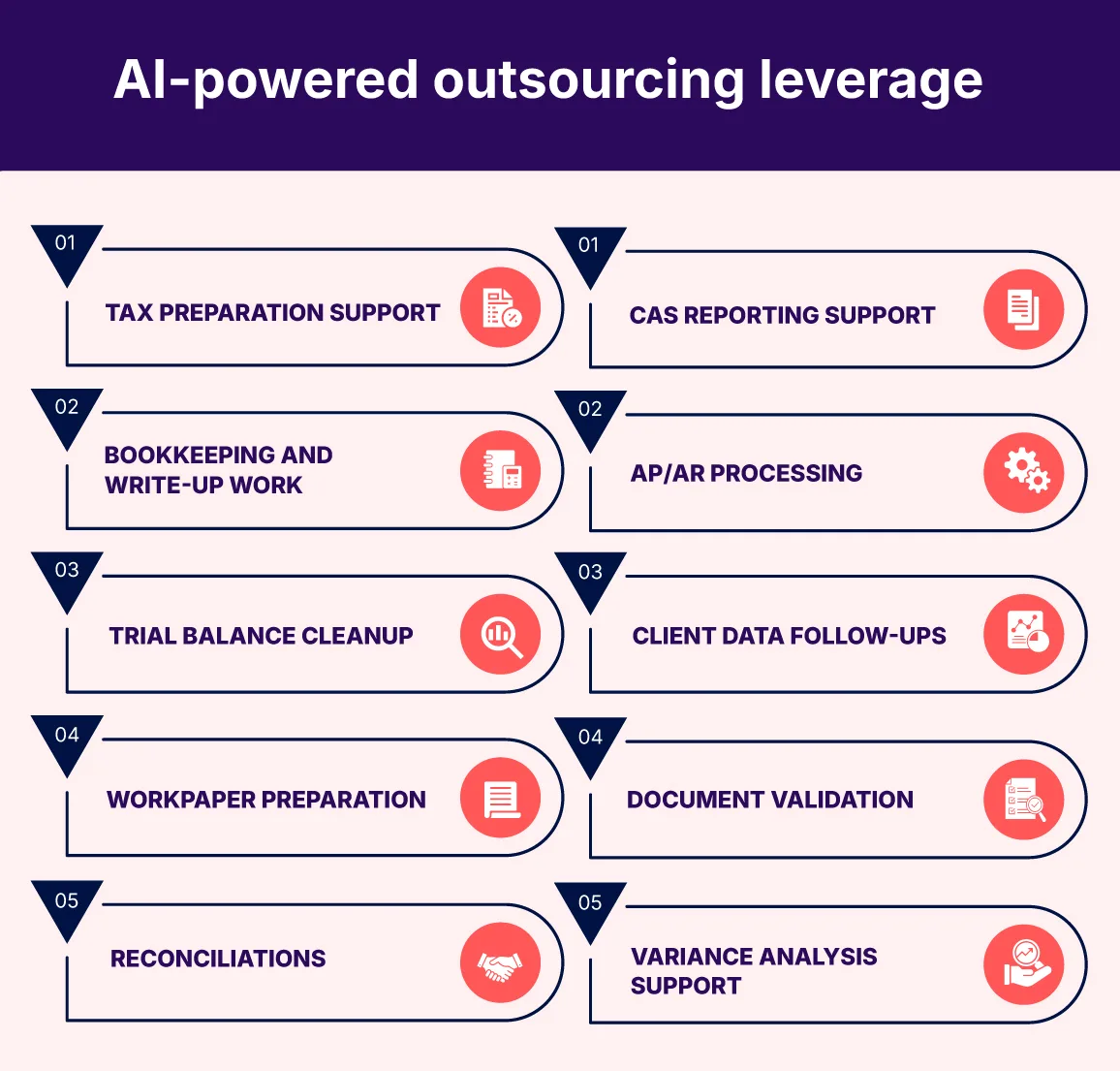
These areas matter because they are closely tied to delivery quality. If they are slow, inconsistent, or poorly prepared, the pressure moves upward to managers, reviewers, and partners.
AI can reduce friction in the preparation layer. Offshore teams can create scalable execution capacity. Internal teams can preserve judgment and client accountability.
That is where the leverage sits. Not in removing humans from the process, but in ensuring humans get to spend time on the right work.
Governance is the difference between scale and risk
For experienced CPA leaders, the biggest barrier to AI and automation is trust.
Can the work be reviewed?
How does client data remain secure?
If offshore teams will follow firm-specific SOPs?
These are not objections. They are the right questions leaders need to ask before introducing any significant change into their internal workflows.
Karbon’s 2025 State of AI in Accounting Report found that while 85% of accounting professionals are optimistic about AI’s potential, 70% still have concerns about data security.
That is why outsourcing backed by technology, cannot run on autopilot, at least not yet.
For firm leaders, the model needs clarity around:
- Defined SOPs
- Ownership by workflow stage
- Human-in-the-loop review
- Exception and escalation rules
- Role-based access
- Secure document workflows
- Audit trails
- SLA visibility
- Quality benchmarks
- Continuous feedback loops
The goal is better oversight, focused on exceptions, judgment, quality, and client impact.
The outsourcing partner has to evolve too
Outsourcing conversations have traditionally centered on what tasks are being offshored, turnaround times, quality control, and cost. That is still important, but it is no longer enough.
If outsourcing is used only as seasonal capacity, it remains tactical. But when outsourcing is integrated with AI-enabled preparation, workflow design, quality control, reporting visibility, and firm-specific SOPs, it becomes part of the operating infrastructure.
That requires a different kind of partner.
CPA firms should expect more than staffing support. They should expect a partner that can help them standardize processes, deploy trained accounting teams, align with existing technology, support governance, and improve delivery visibility.
Many firms want to grow advisory, CAS, tax, or niche services. But growth often stalls because the delivery engine is already overloaded. Outsourcing, coupled with AI, gives firms a practical way to create capacity without giving up control or quality.
This is where Outsourcing 3.0 starts to take shape.
At QXAS, firms don’t just get access to talent but they get access to trained accounting teams, supported by AI-enabled processes, embedded in your workflows, , and aligned to how your firm already operates.
This is the shift from filling gaps to transforming how work gets done.
If you’re exploring what that could look like for your firm, happy to exchange notes.
No pitch, just a candid conversation
Connect with us today!
The real outcome is not efficiency. It is a strategic capacity.
The business case for AI-powered outsourcing is often framed around cost. But if you look at it more closely, that view is too narrow. The more important outcome is capacity creation.
The Future of Professionals 2025 report found that professionals expect AI to save around five hours per week, or nearly 240 hours per year, with an estimated annual value of $19,000 per professional.
But the strategic question is: where does that time go?
If it goes back into more compliance volume, the gains may not be significant.
If it goes into advisory, client relationships, staff development, niche specialization, and partner capacity, the firm gains something more valuable than efficiency. It gains room to grow with greater control.
That is the difference between adopting technology and redesigning the firm.
Beyond Automation
The future CPA firms will not compete on automation alone. They will compete on how intelligently it allocates work across technology, global talent, internal reviewers, and senior judgment.
At QX Accounting Services, we see AI-powered outsourcing as a way to extend firm capability without diluting control. Done well, it helps CPA firms scale delivery, protect quality, reduce pressure on internal teams, and move senior talent closer to the work clients value most.
Outsourcing, backed by automation, can make the firm more scalable, more resilient, and more strategically focused.
For a more detailed discussion, connect with us.
Enquire now

Cora Vollmar
Cora Vollmar is a seasoned professional with over 20 years of experience in accounting, operations, talent management, and business development. Her career began in the construction sector, where she quickly established herself as a leader, achieving triple-digit growth with her CPA team. Cora’s extensive experience includes recruiting for finance and accounting roles, developing innovative STEM-driven solutions to address the U.S. talent deficit, and leading capacity panel discussions across the country.
Recognized as a member of one of America’s fastest-growing construction companies by the Inc. 5000 list for three consecutive years, Cora’s expertise and passion for growth are evident in every aspect of her work. She brings a wealth of knowledge and a dynamic approach to QX Global Group, where she is poised to make a significant impact.
When she’s not working, Cora is an avid traveler with a love for exploring new cultures. She has visited Canada, Mexico, the Caribbean, Europe, the UK, and Central America, with plans to visit Ireland in 2025.
Unauthorized copying or plagiarism of our content is a violation of intellectual property rights. We take such matters seriously and will pursue legal action to protect our original work. Anyone found engaging in such activities will be held accountable under applicable laws.
Don't forget to share this post!
Our Latest Insights




Let’s Work Together
Explore outsourcing solutions, request a no-obligation trial or discuss your practice’s needs with our expert consultants.
 Book a Virtual Meeting
  Get Your ROI Estimate