What Is DCAA Compliance?- A Comprehensive Guide



Summary:
DCAA compliance is a critical requirement for organizations that work with the U.S. government. It governs how costs are recorded, allocated, and audited to ensure proper use of federal funds. This guide explains what DCAA is, what DCAA compliance means in practice, and how businesses can build accounting systems and controls that meet DCAA compliance requirements. It also outlines key audit expectations, common compliance areas, and practical steps to stay prepared and reduce audit risk over time.
DCAA compliance is a set of accounting and financial standards that U.S. government contractors must follow when working on federally funded projects. These standards are designed to ensure transparency, accuracy, and accountability in the tracking and reporting of government funds.
In simpler words, it is the ability to demonstrate that your accounting systems, policies, and cost practices meet federal requirements and can withstand an audit by the Defense Contract Audit Agency.
DCAA compliance requires aligning your accounting practices with federal law and being prepared for ongoing reviews and audits that validate how contract costs are recorded and managed.
The Role of DCAA
To understand compliance, it helps to first answer what DCAA stands for.
It stands for the Defense Contract Audit Agency, a federal agency that operates under the U.S. Department of Defense.
The agency’s primary responsibility is to perform independent financial and accounting audits for government contracts. Its mission is to ensure that taxpayer funds are used appropriately and in accordance with federal regulations.
DCAA audits typically review:
- Cost accounting practices
- Pricing proposals
- Internal controls
- Labor charging systems
- Financial reporting accuracy
It is important to note what is DCAA not responsible for. The agency does not award contracts or negotiate pricing. Instead, it provides audit findings and recommendations to contracting officers who make those decisions. DCAA audits contractors only and does not conduct internal audits for the Department of Defense itself.
What Is a DCAA-Approved Accounting System?
A common misconception is that there is an officially “DCAA-approved” accounting software. According to the DCAA itself, no accounting system is formally approved by the agency.
DCAA evaluates accounting methods, procedures, and internal controls; not software labels. An accounting system is considered acceptable when it follows established DCAA compliance guidelines and demonstrates proper cost segregation, traceability, and documentation.
Why Is DCAA Compliance Accounting Important?
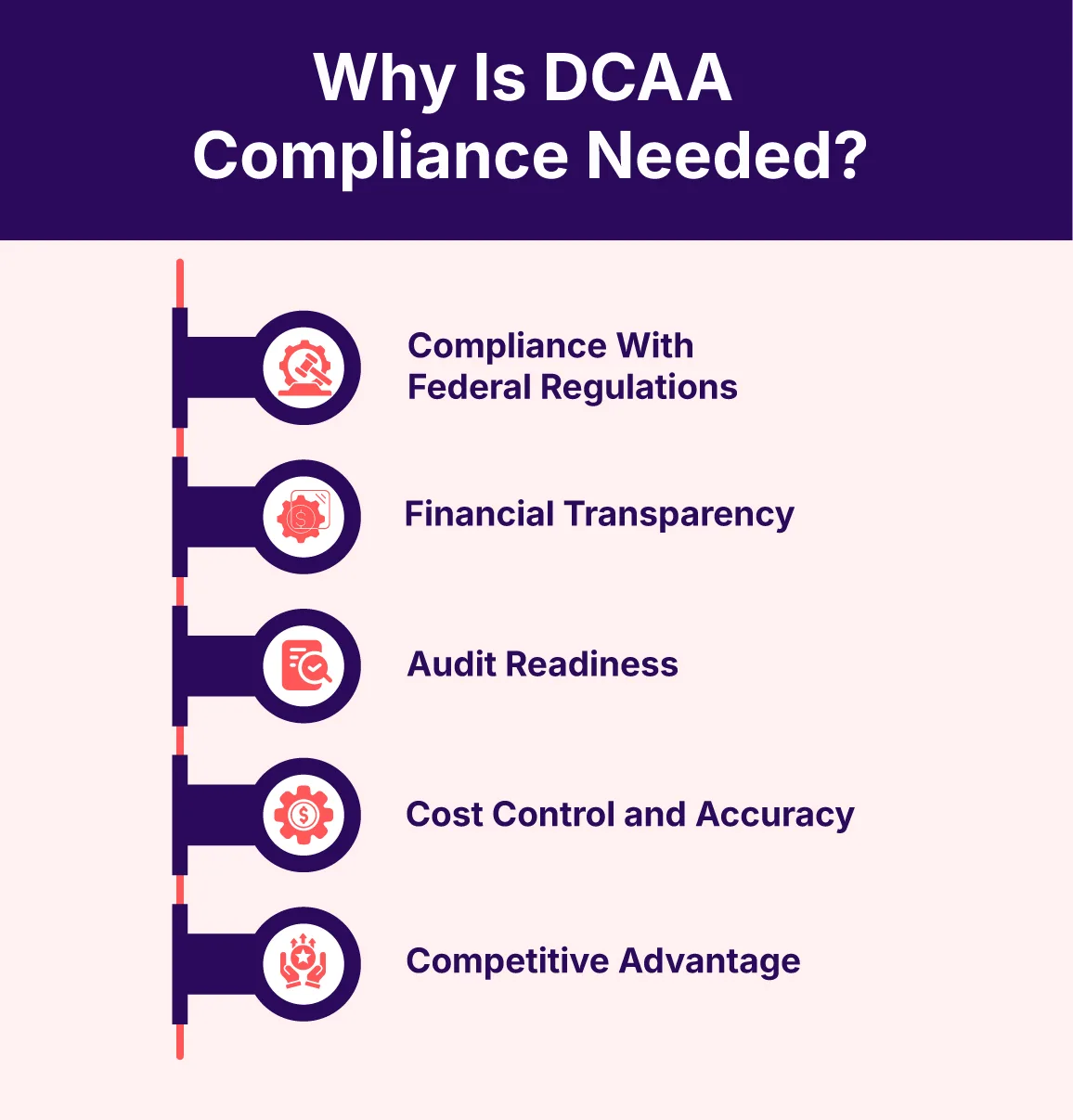
DCAA compliance accounting practices are essential for several reasons. The most important ones are listed below:
Compliance With Federal Regulations
Government contractors must follow strict federal rules. Failure to meet DCAA compliance requirements can result in disallowed costs, contract termination, penalties, or legal exposure.
Financial Transparency
DCAA compliance ensures that all contract-related costs are properly tracked and documented. This level of transparency builds trust with contracting agencies and auditors.
Audit Readiness
Organizations that follow DCAA guidelines are better prepared for audits. Clear policies, consistent procedures, and clean documentation reduce audit findings and speed up reviews.
Cost Control and Accuracy
Accurate cost allocation is critical in government contracting. DCAA compliance guidelines help ensure costs are allowable, allocable, and reasonable under federal standards.
Competitive Advantage
Many agencies prefer contractors with proven compliance histories. Demonstrating strong DCAA practices can improve credibility during proposal evaluations and contract negotiations.
Setting Up an Accounting System to Meet DCAA Compliance Requirements
Achieving compliance requires more than software changes. It depends on people, processes, and controls working together.
1. Understand Applicable DCAA Requirements
DCAA compliance requirements vary by contract type, organization size, and cost structure. Contractors must identify which standards apply to their specific operations using available DCAA guidance.
2. Design or Adapt the Accounting System
Once requirements are identified, configure accounting systems to support cost accuracy, traceability, and reporting. This may involve revising procedures or implementing specialized tools to support compliant workflows.
3. Implement Strong Internal Controls
Internal controls are central to DCAA compliance. These include segregation of duties, documented approval processes, and ongoing monitoring to prevent errors or misuse of funds.
4. Training and Documentation
Employees involved in accounting, timekeeping, and payroll must be trained on DCAA compliance guidelines. Maintain training records and written procedures as evidence during audits.
5. Conduct Regular Reviews
Internal audits and periodic reviews help identify gaps before an official DCAA audit. These activities support continuous improvement and strengthen long-term compliance.
6. Prepare for DCAA Audits
During an audit, organizations must provide timely access to documentation, records, and accounting systems. Preparation minimizes disruptions and improves outcomes.
7. Commit to Continuous Improvement
DCAA compliance is an ongoing process. As regulations evolve, systems must be reviewed regularly to maintain alignment with current requirements.
DCAA Compliance Checklist
Maintaining compliance is critical for organizations working with the Department of Defense. The following three core areas receive close attention during audits.
Timesheet Preparation
Employees must record time daily and charge hours to the correct contract or project. All hours worked, including unpaid overtime, must be captured to ensure accurate labor cost allocation.
Employees are required to certify their timesheets, and any changes must clearly show the original entries, corrections, and the employee’s acknowledgment.
Timekeeping Policy
Supervisors must review and approve timesheets. They may only complete timesheets on behalf of employees during authorized absences, with employee confirmation upon return.
Time must always be charged based on the nature of work performed, not funding availability or contract type.
Labor Charging System
DCAA compliance requires segregation of duties. Timekeeping, payroll, and labor cost accounting should be handled by different roles to prevent conflicts. +
Controls must be reviewed regularly, and any violations should be addressed promptly to protect system integrity.
When Are You Considered “DCAA Compliant”?
During an audit, DCAA evaluates three critical areas:
- Allowability of costs under the Federal Acquisition Regulation (FAR)
- Allocability of costs under Cost Accounting Standards (CAS)
- Reasonableness of costs, often referred to as “quantum”
An organization is considered DCAA compliant when:
- Policies correctly define cost accounting treatment
- Procedures clearly explain how costs are handled
- Actual accounting practices align with d
Wrapping It Up
DCAA is about building accounting discipline that stands up to scrutiny at any time.
Organizations that understand what DCAA expects, align their accounting systems accordingly, and maintain strong internal controls win and retain government contracts. More importantly, they reduce audit risk, improve cost visibility, and operate with greater confidence.
When DCAA compliance is treated as an ongoing practice rather than a one-time project, audits become validation exercises instead of disruptions. That shift is what separates contractors who struggle with compliance from those who scale successfully in the government contracting space.
FAQs
1. What is DCAA compliance in simple terms?
DCAA compliance means your accounting system, policies, and cost practices meet federal requirements for government contracts. It ensures costs are properly tracked, allocated, and documented. Compliance allows contractors to pass audits and continue working on federally funded projects.
2. What does DCAA stand for, and what does it do?
DCAA stands for the Defense Contract Audit Agency. It is a federal agency under the U.S. Department of Defense that audits government contractors. Its role is to verify that contract costs are accurate, allowable, and compliant with federal regulations.
3. Is there such a thing as a DCAA-approved accounting system?
No. DCAA does not approve specific software. Instead, it evaluates whether your accounting methods, procedures, and controls meet DCAA compliance guidelines. Any system can be acceptable if it supports compliant practices.
4. What are the most common DCAA compliance requirements?
Key requirements include accurate timekeeping, proper labor charging, segregation of duties, documented internal controls, and consistent cost allocation. Contractors must also maintain clear audit trails and supporting documentation.
5. How do companies stay DCAA compliant over time?
Staying compliant requires ongoing effort. Regular internal reviews, employee training, updated documentation, and periodic system checks are essential. Organizations that treat compliance as a continuous process are far better prepared for audits.

Cora Vollmar
Cora Vollmar is a seasoned professional with over 20 years of experience in accounting, operations, talent management, and business development. Her career began in the construction sector, where she quickly established herself as a leader, achieving triple-digit growth with her CPA team. Cora’s extensive experience includes recruiting for finance and accounting roles, developing innovative STEM-driven solutions to address the U.S. talent deficit, and leading capacity panel discussions across the country.
Recognized as a member of one of America’s fastest-growing construction companies by the Inc. 5000 list for three consecutive years, Cora’s expertise and passion for growth are evident in every aspect of her work. She brings a wealth of knowledge and a dynamic approach to QX Global Group, where she is poised to make a significant impact.
When she’s not working, Cora is an avid traveler with a love for exploring new cultures. She has visited Canada, Mexico, the Caribbean, Europe, the UK, and Central America, with plans to visit Ireland in 2025.
Unauthorized copying or plagiarism of our content is a violation of intellectual property rights. We take such matters seriously and will pursue legal action to protect our original work. Anyone found engaging in such activities will be held accountable under applicable laws.
Don't forget to share this post!
Our Latest Insights




Let’s Work Together
Explore outsourcing solutions, request a free trial or discuss your practice’s needs with our expert consultants.
 Book a Virtual Meeting
  Get Your ROI Estimate