



The UK accounting profession stands at a crossroads.
On the one hand, decision-makers in SME practices are navigating historically high operating costs: rising wages, inflationary pressures, compliance complexity, and an increasingly competitive client market. On the other, the classic pyramid operating model, heavy on junior staff supporting a handful of seniors, is crumbling under these very pressures, impeding growth rather than enabling it.
To thrive in 2026 and beyond, firms must move beyond tradition. They need a new structural paradigm – one that harnesses talent and technology in symbiosis, freeing up capable people for strategic, revenue-driving work.
At QX Accounting Services, we call this the Diamond Model, enabled through our specialised accounting outsourcing framework, what we call Outsourcing 3.0: Talent + Tech + Transformation. Before we explore that, let’s unpack the underlying forces pushing firms to abandon the old ways.
Recruitment and retention have become the top constraint for UK accounting firms. Multiple industry reports show:
This isn’t just anecdotal. The pipeline of qualified accountants isn’t keeping pace with demand, and firms are forced into trade-offs between taking on new clients and maintaining service quality.
This dynamic exposes a fatal flaw in the pyramid model: it assumes an endless supply of junior labour to absorb the checklist work that truly keeps firms afloat. That assumption no longer holds.
Labour cost inflation is squeezing margins. A range of statutory pay rises and related employer costs are driving this:
Even when accountants are above minimum wage, wage growth across the sector continues to outpace productivity in many services industries.
For firms still built on large pools of junior staff, this equates to a significant and rising wage bill burden with little corresponding improvement in efficiency.
For decades, the pyramid model comprising large numbers of junior staff doing transactional work beneath a shrinking number of seniors, worked because:
Today, none of these assumptions hold.
This creates a mismatch: firms structured around volume of low-value work struggle to generate the margin needed to invest in people, technology, or growth initiatives. The result? Stagnant growth and overworked teams.
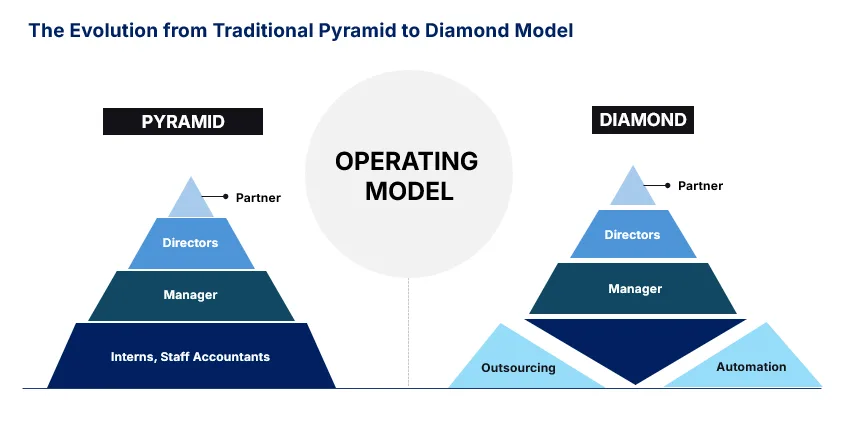
Enter the Diamond Model – a structure that’s already starting to shape future-focused practices. Its core principles:
Instead of a broad base of junior accountants, leverage specialised, cost-efficient teams (internal and external) who can handle standardised work more cheaply and consistently.
Middle teams comprising managers and senior accountants become the engine of delivery and innovation. Freed from repetitive tasks by tech and support teams, they take on higher-value work such as advisory, client strategy, and risk management.
Partners and directors spend less time firefighting and more time on growth activities, strategic client development, and service innovation.
This isn’t theory; it’s where the market is heading. Consultancies are already shifting away from traditional hierarchical staffing and reducing reliance on entry-level roles in favour of tech-empowered and outcome-focused teams.
Many practices recognise the need for digital transformation. But technology without a reimagined operating model only delivers marginal gains.
Outsourcing 3.0, as we define it at QX, is different. It blends:
This blended approach enables firms to:
The result is not merely a cost-saving exercise, but a strategic leverage model that supports growth.
If you’re aiming to expand over the next five years, continuing with yesterday’s operating assumptions is a risk, not a strategy.
Real growth in today’s market requires:
Done right, this approach ushers firms into a virtuous cycle: efficiency enables capacity, capacity enables innovation, and innovation drives growth.
Shifting away from a traditional pyramid sounds compelling on paper. The harder part is execution.
This is where most firms get stuck, not because they lack ambition, but because re-engineering an operating model while running a busy practice feels risky and resource-heavy.
At QX, we don’t treat outsourcing as a hand-off of work. We treat it as an operating model redesign, delivered through what we call Outsourcing 3.0 – Talent, Tech, and Transformation working together.
Here’s how it actually works.
Everything starts with a proper discovery conversation, not a sales pitch.
We take time to understand:
This stage is about clarity. Until that exists, no operating model change will stick.
Next, we conduct a structured assessment of:
What often emerges is eye-opening: highly qualified people spending hours on work that could be standardised, automated, or delivered differently without loss of quality.
We then present a clear, practical assessment of:
This isn’t theoretical consulting. It’s a blueprint for a smarter operating model, aligned to the Diamond structure: leaner at the base, stronger through the middle, and strategic at the top.
Once the model is defined, we identify and deploy the right experts for the job – people with the technical capability, domain knowledge, and mindset to integrate into your firm.
QX teams don’t sit in isolation. They work as an extension of your practice, aligned to:
We also support onboarding and transition, ensuring your internal teams are comfortable, confident, and in control.
Talent alone doesn’t deliver scale. That’s why we embed smart automation and workflow technology into the delivery model.
This includes:
The focus is simple: less friction, fewer bottlenecks, and more time back where it matters.
The Outcome: Space to Think, Lead, and Grow
When the model clicks, the impact is tangible.
Most importantly, firms regain something that’s been in short supply for years: time. Time to innovate, time to deepen client relationships, and time to build a firm that’s fit for the next decade, not the last.
Want to explore how this model could work for your firm? Connect with us and our expert will get back to you for a free strategy session.
The pyramid model served its purpose in an era of ample resources and predictable workflows. But in the UK’s current climate, marked by labour scarcity, rising wage bills, and client demand for higher-value services, it’s become an anchor on growth.
Leaders who recognise this and embrace operating models built around tech-enabled talent and strategic transformation, will be the ones positioning their firms for strength in 2026 and beyond.
If you’re ready to move past “more hours, more bodies” thinking and reshape how your firm delivers value, the Diamond Model and Outsourcing 3.0 offer not just a way forward, but a competitive edge.

Mustufa is a Chartered Accountant with 10 years of progressive experience across Indian, Canadian, and UK accounting domains. He has a proven track record of leading high-performing teams of 60+ members, managing multi-client portfolios, and driving operational excellence with measurable profitability improvements.
Unauthorized copying or plagiarism of our content is a violation of intellectual property rights. We take such matters seriously and will pursue legal action to protect our original work. Anyone found engaging in such activities will be held accountable under applicable laws.
Explore outsourcing solutions, request a no-obligation trial or discuss your practice’s needs with our expert consultants.





 Book a Virtual Meeting
  Book an In-person Meeting