



The context of growth has changed significantly for accounting firms over the past decade. Alongside in-house teams, outsourcing has become critical to enhancing productivity and overall firm efficiency.
It is no longer simply a way to reduce costs or address staffing shortages. It has more to contribute in a firm’s growth, by creating capacity and filling critical gaps in processes.
The challenge, however, is not whether outsourced accounting works. It is whether firms can maintain the same level of quality, consistency, and client confidence as volumes increase. This concern is entirely justified.
According to ICAEW, outsourcing and offshoring have become embedded within the operating models of firms of all sizes. At the same time, the institute emphasises the importance of strong quality controls to ensure outsourced work meets professional standards and supports audit quality. The same research found talent shortages remain one of the biggest concerns across the profession, driving more firms towards outsourced delivery models.
Partners and directors are asking important questions:
The answer lies in building robust quality control systems.
The most successful firms understand that outsourcing should never mean giving up control. In fact, when supported by strong quality governance, documented review processes, and measurable service standards, outsourcing can often improve consistency and accountability.
The modern accounting firm faces increasing pressure from multiple directions. At the same time, even small errors can have significant consequences:
This is why quality control in outsourced accounting is no longer a back-office consideration. It is a strategic business priority.
The firms achieving the best outsourcing outcomes are not necessarily those with the largest teams. They are the firms with the strongest quality management frameworks.
Quality control in outsourced accounting services refers to the systems, processes, and governance mechanisms used to ensure outsourced work is:
It encompasses every stage of the delivery process, including:
Put simply, good outsourced accounting quality standards ensure that every VAT return, set of statutory accounts, tax computation, management report, or bookkeeping assignment meets predefined expectations before it reaches the client.
Before assigning a single ledger to an external provider, you must establish clear rules of engagement. This begins with robust quality governance in outsourced accounting. Governance isn’t just about checking a trial balance; it is about creating a comprehensive structure that dictates how work is completed, reviewed, and finalised.
When developing this framework, strict adherence to compliance standards in accounting outsourcing is paramount. Your clients trust you to navigate the complexities of British tax and financial reporting. Consequently, your outsourced team must operate within the same rigorous parameters.
Key pillars of compliance include:
Quality begins long before any accountant starts working on a file.
Leading accounting outsourcing providers rely on documented workflows and standard operating procedures that create consistency across every engagement.
This includes:
When processes are documented and repeatable, firms reduce dependency on individual knowledge and minimise variability in output quality.
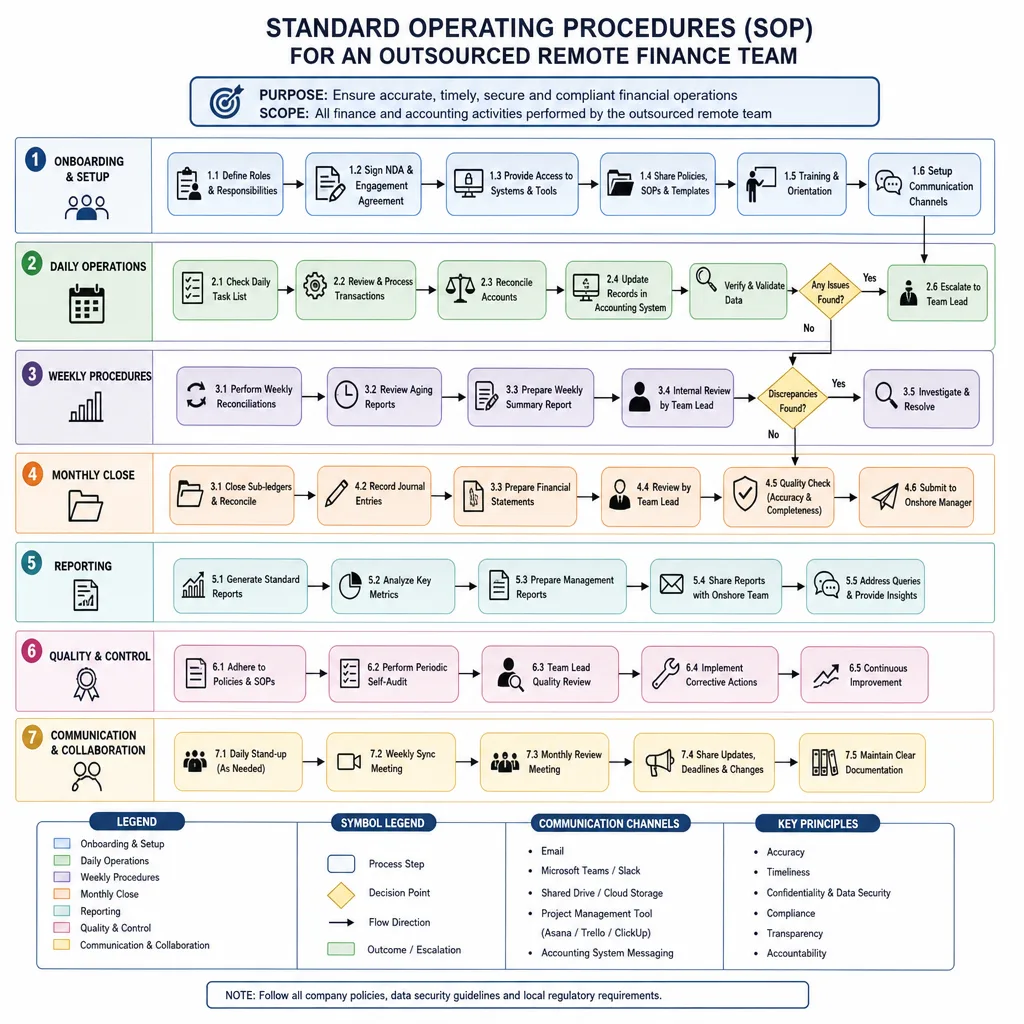
One of the biggest misconceptions about outsourcing is that work is completed by a single individual and delivered directly to the client.
In reality, strong accounting outsourcing quality assurance involves multiple review layers.
A typical framework may include:
Verification of:
Assessment of:
Focus on:
This layered approach significantly reduces error rates while ensuring work is review-ready upon submission.
Secure and compliant accounting outsourcing must align with UK regulatory expectations.
This includes adherence to:
Effective quality management in outsourced accounting requires ongoing monitoring of regulatory developments and continuous training to ensure compliance standards remain current.
One of the strongest quality governance tools available to accounting firms is a well-defined SLA framework. Without measurable expectations, quality becomes subjective.
Strong SLAs typically define:
Meanwhile, Key Performance Indicators (KPIs) allow firms to monitor quality objectively.
Common accounting outsourcing KPIs include:
These measures transform quality conversations from opinion-based discussions into performance-based management.
Quality is never a one-time project. The most successful outsourcing relationships rely on ongoing performance reviews.
This includes:
Continuous improvement prevents recurring issues and helps quality standards evolve alongside the firm’s growth.
If you can’t measure quality, you can’t manage it. Leading firms monitor several indicators to assess accounting outsourcing services quality.
Many firms discover that partner review time is one of the most revealing indicators. When outsourced work consistently arrives review-ready, partner capacity increases dramatically.

Even with the best frameworks in place, vigilance is required. Implementing proactive risk mitigation strategies for offshore bookkeeping helps your firm catch minor discrepancies before they escalate into major client issues.
Your onshore managers should be trained to spot common red flags in outsourced financial reports. These often include:
Spotting these red flags early is the essence of effective quality management in outsourced accounting. It allows you to provide constructive feedback to the remote team, fostering continuous improvement.
Also Read: Best Accounting Outsourcing Firms in the UK
Strong governance separates successful outsourcing relationships from problematic ones.
A robust governance framework typically includes:
Some firms also prefer working with providers operating under recognised quality frameworks such as ISO 9001 Quality Management systems, which emphasise process consistency and continuous improvement.
Before selecting a provider, accounting firm leaders should ask:
The answers to these questions often reveal far more than pricing discussions ever will.
At QX Accounting Services, we believe quality control should be designed into every stage of the outsourcing journey, not added as an afterthought.
Our approach combines:
For more than two decades, we have supported UK accounting firms with scalable delivery models that protect quality while increasing capacity.
Whether supporting bookkeeping, VAT, accounts preparation, tax services, payroll, management accounts, or audit support, our focus remains the same:
Helping firms grow without increasing partner review burden or compromising service quality.
Because ultimately, outsourcing should strengthen quality, not create additional risk.
Most firms establish documented workflows, implement multi-level reviews, monitor performance through KPIs, conduct regular audits, and maintain governance structures that ensure accountability and consistency.
Outsourcing providers should use standard operating procedures, checklist-based reviews, technical reviews, compliance checks, escalation processes, staff training programmes, and continuous improvement frameworks.
Accounting firms should monitor accuracy rates, rework percentages, turnaround times, SLA achievement, client feedback, compliance exceptions, and partner review effort.
SLAs define expected performance standards, while KPIs provide measurable indicators that allow firms to monitor accounting outsourcing service quality objectively.
Errors can be reduced through standardised processes, clear instructions, documented review procedures, automation, staff training, and root cause analysis of recurring issues.
Effective governance frameworks include service reviews, escalation mechanisms, performance reporting, compliance audits, risk management processes, and clearly assigned ownership.
Assess their review frameworks, quality assurance procedures, compliance expertise, KPI reporting capabilities, training programmes, security controls, and track record of delivery.
The most effective practices include standardised workflows, documented procedures, review-ready delivery standards, KPI monitoring, continuous improvement initiatives, and strong communication between teams.
For many accounting firms, the question is no longer whether to outsource. It is how to outsource without compromising quality.
The firms seeing the greatest success treat quality control in outsourced accounting services as a strategic capability. They build governance into the relationship from day one, establish clear accountability, measure performance rigorously, and partner with providers that understand professional standards.
When done correctly, outsourcing does not mean less control.
It means creating a more scalable, predictable, and resilient delivery model, one that allows partners and directors to focus on what matters most: serving clients, growing the firm, and building long-term value.

Deepika is a seasoned accounting professional with over 13 years of experience spanning the Indian, US, and UK markets. Her expertise covers audit, iXBRL, bookkeeping, VAT, taxation, and both management and statutory accounts preparation and review for limited companies, partnerships, and NRLs. She also brings specialised knowledge in conducting Independent Examinations for not-for-profit organisations, ensuring accuracy, compliance, and value-driven outcomes for diverse clients.
Unauthorized copying or plagiarism of our content is a violation of intellectual property rights. We take such matters seriously and will pursue legal action to protect our original work. Anyone found engaging in such activities will be held accountable under applicable laws.

25 September 2026
Explore outsourcing solutions, request a no-obligation trial or discuss your practice’s needs with our expert consultants.

![Two business colleagues discuss at a wooden table, each using a laptop in a sunlit office.]','Two men in smart casual and a suit work together on laptops at a conference table.]','Co-workers collaborating on a project in a modern office with large windows.]','Two professionals reviewing data on their laptops during a meeting at a glass-topped table.]','Business partners discussing strategy at a table by windows in a bright office.](https://qxaccounting.com/uk/wp-content/uploads/sites/2/2026/09/Questions-to-Ask-Before-Choosing-a-Tax-Outsourcing-Partner.webp)


 Book a Virtual Meeting
  Book an In-person Meeting