What’s an SLA: Types, Need, Benefits & Best Practices



Summary:
Outsourcing accounting can deliver efficiency and scale, but only when expectations are clearly defined. A Service Level Agreement (SLA) plays a critical role in setting standards for delivery, quality, communication, and accountability. This blog explains what an SLA is, why it matters in accounting outsourcing, the key components every firm should include, and the risks of operating without one.
Outsourcing accounting can unlock efficiency, flexibility, and cost control. But without clear expectations, it can just as easily create delays, rework, and frustration. That is why a an SLA in CPA outsourcing is critical. It defines how work gets done, how performance is measured, and how accountability is maintained. More importantly, it protects both the firm and the outsourcing partner from misalignment.
This blog covers all the major points around an SLA. Let us decode these one by one.
What Is an SLA (Service Level Agreement)?
An SLA, or Service Level Agreement, is a formal document that outlines the scope, standards, and expectations of a service relationship. In context of CPA outsourcing SLA, it typically defines:
- What services are provided
- How quickly work is delivered
- What quality standards apply
- How communication and escalation work
- How performance is tracked and reviewed
A well-structured accounting outsourcing SLA ensures both sides operate with clarity. It helps firms maintain service quality while providing providers with a clear framework for delivering consistent outcomes.
What are the different types of SLAs?
Although SLAs are structured documents, but they aren’t identical. Each SLA is structured differently. The format depends on the industry, service model, complexity, and client requirements.
Within a CPA firm outsourcing agreement, these are the most common SLA types that one can find:
- Customer-based SLA
This is tailored to a specific client and their unique requirements. It includes metrics, SOPs, and workflows, all aligned to customers’ needs and expectations. - Service-based SLA
This SLA focuses on a specific service across multiple clients. For example, a standard SLA for outsourced bookkeeping may define uniform timelines and accuracy benchmarks. Similarly, a standard SLA for outsourced paroll will define the TAT and benchmarks according to this service. - Operational SLA
This covers internal performance metrics such as uptime, maintenance, and system reliability. The SLAs under this category are critical in an offshore accounting SLA, where consistency across locations matters. - Multi-level SLA
This SLA combines multiple layers. It blends customer-specific requirements with standard service benchmarks for flexibility and control.
Key Components of an Effective Accounting SLA
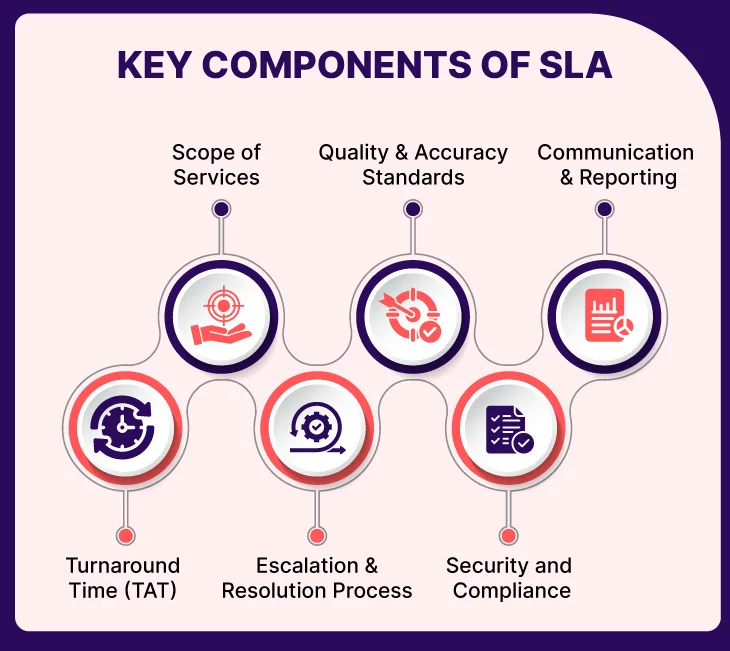
Here are the key components every CPA outsourcing SLA should include:
1. Scope of Services
Defines exactly what is included and excluded. This avoids scope creep and ensures both sides agree on responsibilities from the start.
2. Turnaround Time (TAT)
Specifies delivery timelines for each task type. This is critical during close cycles, tax season, and reporting deadlines.
3. Quality and Accuracy Standards
Outlines acceptable error rates and review processes. In an accounting outsourcing SLA, quality must be measurable.
4. Communication and Reporting
Sets cadence for updates, reviews, and performance reporting. This keeps both teams aligned and issues visible from the outset.
5. Escalation and Resolution Process
Defines how and when issues are raised and resolved. Problems are addressed quickly instead of lingering.
6. Security and Compliance
Covers data protection and regulatory requirements. This is essential in any offshore accounting SLA handling financial data.
Control, Accountability, and Predictable Outcomes

Discover how SLA-driven accounting outsourcing protects quality and turnaround.
A well-structured accounting outsourcing SLA ensures both sides operate with clarity. It helps firms maintain service quality while giving providers a clear framework to deliver consistent outcomes.
Start the conversation arrow_forwardWhy an SLA Matters in Accounting Outsourcing
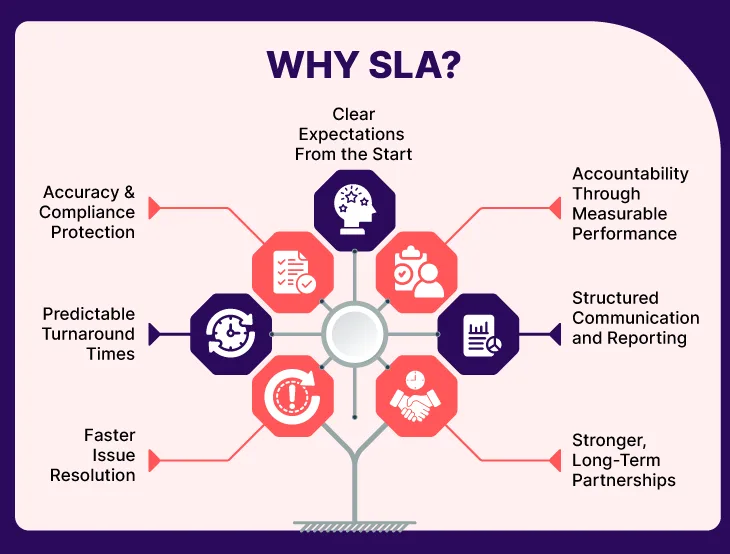
Accounting work is time-sensitive, accuracy-driven, and compliance-heavy. Without structure, even small delays or errors can have outsized consequences. An SLA in CPA outsourcing ensures consistency across delivery. It sets clear turnaround times, quality benchmarks, and ownership for every task. This reduces ambiguity and keeps workflows predictable.
It also creates accountability. When expectations are documented, performance can be measured objectively instead of debated subjectively. Not to forget, an SLA also aligns outsourcing delivery with business priorities. The work supports deadlines, peak seasons, and reporting needs rather than operating in isolation.
1. Clear Expectations From the Start
An SLA clearly defines what work is included, how it will be delivered, and the expected standards. Both sides are aware of their responsibilities from the outset. This reduces confusion and prevents scope creep as work scales.
2. Accuracy and Compliance Protection
Accounting errors can quickly turn into compliance risks. An SLA sets clear accuracy thresholds and review standards. This ensures that outsourced work consistently meets regulatory and internal quality expectations.
3. Accountability Through Measurable Performance
Without an SLA, performance is often judged subjectively. A service level agreement establishes measurable benchmarks, including turnaround time and error rates. This makes performance transparent and easier to manage.
4. Predictable Turnaround Times
Timely delivery is critical in accounting workflows. An SLA defines turnaround times for routine work and peak periods. This helps businesses plan confidently and avoid last-minute delays.
5. Structured Communication and Reporting
Poor communication is a common challenge in outsourcing. An SLA establishes a clear communication cadence, reporting formats, and designated points of contact. This keeps teams aligned and reduces the need for back-and-forth communication.
6. Faster Issue Resolution
Issues are inevitable, but delays are not. An SLA outlines escalation paths and response timelines. This ensures problems are addressed quickly before they affect delivery.
7. Stronger, Long-Term Partnerships
Consistent service builds trust over time. An SLA reinforces reliability and stability in the outsourcing relationship. It allows outsourcing to evolve from a cost decision into a long-term strategic partnership.
An impressive SLA compliance rate exceeds 95%. This reflects that a company satisfactorily delivers on its promises and upholds high quality standards, deepening trust with its customers.
Related Blog: Secure Accounting Outsourcing for CPA Firms in 2026: An Expert Guide
What Happens Without an SLA or Service Level Agreement?
Without an SLA or a CPA firm outsourcing agreement, expectations remain informal and often misaligned. Turnaround times slip because priorities are unclear. Quality issues increase because standards are not documented. Communication becomes reactive instead of structured.
Problems surface late, escalations lack clarity, and accountability is hard to enforce. Over time, outsourcing starts to feel unpredictable rather than supportive.
Also Read: Top Accounting outsourcing Companies in USA
Final Thoughts
An SLA, or Service Level Agreement, is the backbone of a successful accounting outsourcing arrangement. It brings clarity, control, and consistency to the relationship. However, an SLA only works when it is designed, monitored, and enforced correctly. This is where a strategic partner matters.
At QX accounting Servcies SLAs are based on real delivery metrics, including turnaround time, accuracy, communication, and outcomes. Combined with structured workflows and strong governance, this ensures outsourcing runs smoothly, even during peak periods.
If you want outsourcing to be predictable, scalable, and reliable, start with the right SLA and the right partner. Connect with QXAS to see how a well-defined SLA can turn outsourcing into a long-term advantage.
FAQs
1. What is an SLA in accounting outsourcing?
An SLA in CPA outsourcing is a formal document that defines performance standards, turnaround times, quality benchmarks, and responsibilities between an accounting firm and its outsourcing provider. It sets clear expectations and accountability from day one.
2. Why is a service level agreement important when outsourcing accounting?
A CPA outsourcing SLA ensures consistent delivery, predictable turnaround times, and measurable quality. Without an SLA, firms risk delays, miscommunication, and inconsistent output, particularly during peak periods such as tax season.
3. What should an SLA include for outsourced accounting services?
An effective SLA should cover the scope of work, turnaround times, accuracy thresholds, communication protocols, escalation paths, data security standards, and reporting frequency. These components protect both parties and reduce operational risk.
4. Can an SLA be customized for different accounting workflows?
Yes. A strong service level agreement should be tailored to specific workflows such as bookkeeping, AP/AR, payroll, or tax preparation. Custom SLAs ensure the outsourcing model aligns with your firm’s processes and client commitments.
5. How does an SLA help improve outsourcing outcomes long term?
An SLA creates transparency and continuous improvement by tracking performance against agreed benchmarks. Over time, this helps firms optimize delivery, maintain quality, and build a more reliable outsourcing partnership.
6. What are the different types of SLAs?
There are four main types of SLAs used in outsourcing. Customer-based SLAs are tailored to a specific client. Service-based SLAs apply to a standard service across multiple clients. Operational SLAs define internal performance metrics. Multi-level SLAs combine all these layers within a CPA firm outsourcing agreement.
7. What KPIs should you track in an SLA for accounting outsourcing?
A strong accounting outsourcing SLA should track key measurable KPIs. These include turnaround time (TAT), accuracy rates, rework levels, on-time delivery, and communication response time. In a CPA outsourcing SLA, firms should also track compliance adherence and audit readiness. These metrics ensure performance is consistent and aligned with critical business goals.
8. What are the common mistakes to avoid when creating an SLA?
Common mistakes include non-definitive or vague scope definitions, unrealistic timelines, and lack of measurable KPIs. Many firms also overlook communication protocols, governance SOPs and escalation paths. In an SLA in CPA outsourcing, failing to define quality benchmarks or security standards can also create performance risk. A poorly structured offshore accounting SLA often leads to delays, errors, and misalignment.

Cora Vollmar
Cora Vollmar is a seasoned professional with over 20 years of experience in accounting, operations, talent management, and business development. Her career began in the construction sector, where she quickly established herself as a leader, achieving triple-digit growth with her CPA team. Cora’s extensive experience includes recruiting for finance and accounting roles, developing innovative STEM-driven solutions to address the U.S. talent deficit, and leading capacity panel discussions across the country.
Recognized as a member of one of America’s fastest-growing construction companies by the Inc. 5000 list for three consecutive years, Cora’s expertise and passion for growth are evident in every aspect of her work. She brings a wealth of knowledge and a dynamic approach to QX Global Group, where she is poised to make a significant impact.
When she’s not working, Cora is an avid traveler with a love for exploring new cultures. She has visited Canada, Mexico, the Caribbean, Europe, the UK, and Central America, with plans to visit Ireland in 2025.
Unauthorized copying or plagiarism of our content is a violation of intellectual property rights. We take such matters seriously and will pursue legal action to protect our original work. Anyone found engaging in such activities will be held accountable under applicable laws.
Don't forget to share this post!
Our Latest Insights




Let’s Work Together
Explore outsourcing solutions, request a free trial or discuss your practice’s needs with our expert consultants.
 Book a Virtual Meeting
  Get Your ROI Estimate