Outsourcing Payroll: How It Works, Benefits, Costs & More



Summary:
Payroll often looks simple on the surface, but behind the scenes, it’s a compliance-heavy, error-prone process that consumes significant time and attention. Outsourcing payroll helps firms shift this operational load to specialists, reduce Risk, and free up internal teams for higher-value work. This blog breaks down how outsourced payroll services work, their benefits, costs, and what to look for in the right partner.
Picture your team focused on advisory and strategy, not bogged down by payroll tasks. No more chasing pay slips, rechecking calculations, or stressing over payroll filings.
Seems like a “Nice-to-have” thing? Well, this is something your firm should aim to achieve strategically in 2026.
Thanks to Outsourcing Payroll, the above-mentioned scenario is 100% achievable. While your team is handling the strategic tasks focused on growth and bringing in business, there’s an extended team member (probably not in your office) working diligently and quietly to keep the payroll function running in the background.
Industry data shows that roughly 39% of businesses outsource payroll, reflecting a widespread trend toward efficiency and compliance management.
This blog covers the essentials to understand the payroll function & its outsourcing in depth. Let us start with the very basics.
What Is Payroll Outsourcing?
At its core, outsourcing payroll means delegating the tasks and processes involved in paying employees to a third-party provider. These payroll service providers are responsible for all payroll activities, including computing wages, deducting taxes, and preparing paychecks or issuing direct deposits. They ensure full compliance with tax laws and employment regulations.
Payroll activities further include:
- Gross-to-net payroll calculations
- Payroll tax filing and payments
- Compliance with labour and tax laws
- Employee recordkeeping and reporting
- Generation of payslips and statutory documents
This outsourced payroll model enables internal teams to focus on core business activities rather than complex and redundant payroll tasks.
How Payroll Outsourcing Works ?
Before outsourcing payroll, it is important to understand the day-to-day process involved in this function. Each step, from onboarding payroll service providers to managing compliance and reporting, follows a defined workflow.
Before thinking about outsourcing, clearly define the support you require. Specify which payroll activities will be covered under managed payroll services.
The following outlines how outsourcing payroll works in practice.
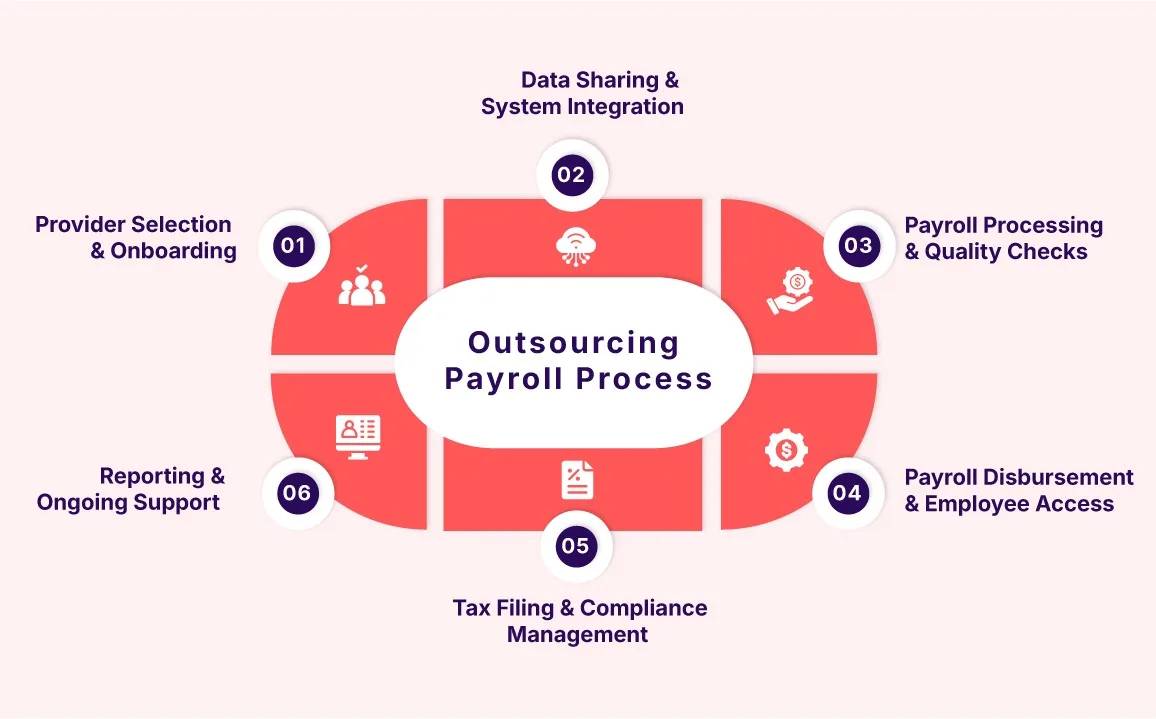
1. Provider Selection & Onboarding
The first step is to select a payroll service provider that matches your firm’s size, compliance requirements, technology, and security standards. Next is onboarding, establishing standard operating procedures, and confirming compliance expectations.
2. Data Sharing & System Integration
Employee credentials, pay slips, and tax filings are highly confidential. Ensure you understand the vendor’s security protocols for sharing and managing this data.
Your Payroll Data Deserves More Than Spreadsheets
Move from fragmented delivery model to a secure, integrated payroll workflow. Connect with us today!
Click Here!
3. Payroll Processing & Quality Checks
The provider performs gross-to-net calculations, applies deductions, and manages statutory contributions each pay cycle. Validation checks are conducted to identify errors before finalizing payroll.
4. Payroll Disbursement & Employee Access
Salaries are disbursed via direct deposit or other approved methods after authorization.
Employees access payslips and tax documents through secure self-service portals.
5. Tax Filing & Compliance Management
Payroll tax filings and statutory submissions are completed in accordance with regulations.
Managed payroll services, monitored regulatory changes to ensure ongoing compliance.
6. Reporting & Ongoing Support
Firms receive payroll reports detailing costs and liabilities. Ongoing support includes updates for new hires, terminations, and pay adjustments.
Who All Can Use Outsourced Payroll?
- Small businesses that lack internal payroll expertise
- Growing companies needing scalable solutions
- Multistate or international businesses navigating complex compliance
- Organizations aiming to reduce administrative workload through third-party payroll processing
Benefits of Outsourcing Payroll
When payroll is handled externally, the gains go beyond “routine task delegation”. Firms see improvements across productivity, accuracy, and compliance with managed payroll services.
Here are some of the top benefits of payroll outsourcing
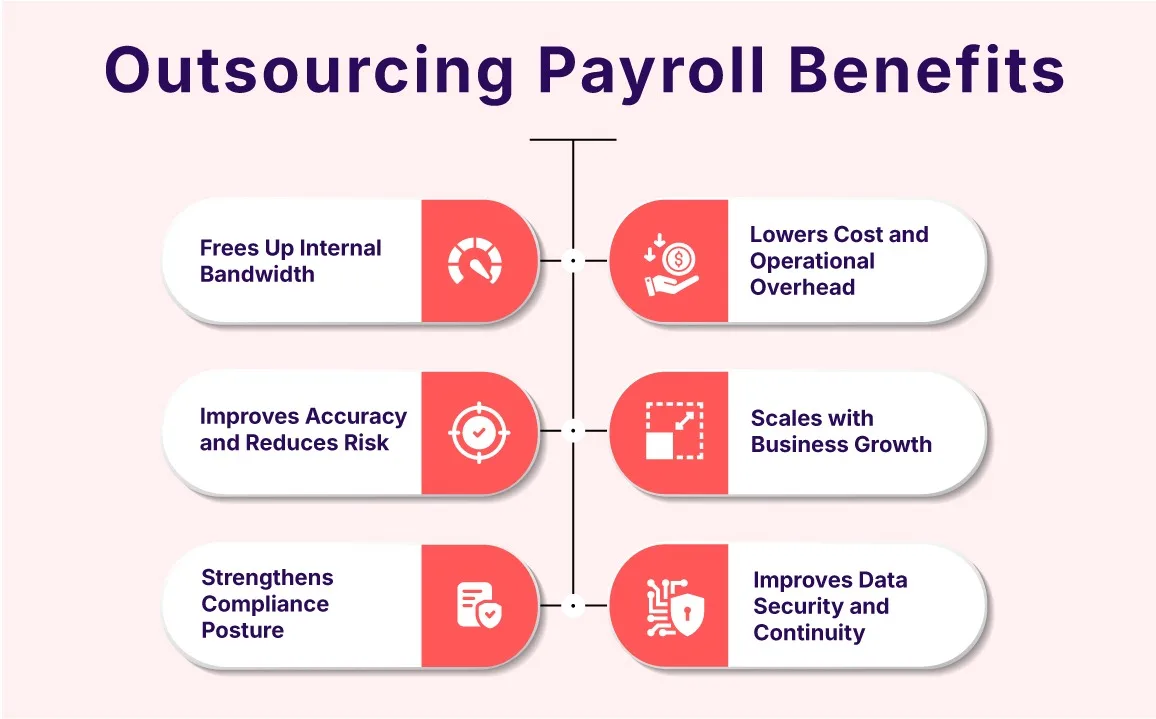
1. Frees Up Internal Bandwidth
Outsourcing payroll removes a recurring operational load from finance and HR teams.
This frees up time for higher-value work, such as advisory, planning, and client-facing priorities.
Teams spend less time fixing payroll issues and more time on strategic initiatives.
2. Improves Accuracy and Reduces Risk
Payroll service providers run system-driven processes, aligned with SOPs. This reduces manual errors in calculations, deductions, and filings. Fewer errors also mean less rework for internal teams.
3. Strengthens Compliance Posture
Payroll regulations and tax rules change frequently and vary by jurisdiction. Outsourced providers track these changes and update processes accordingly. This lowers the Risk of missed filings, penalties, and compliance gaps.
In fact, about 40% of small businesses incur IRS penalties each year due to payroll irregularities. This makes accurate processing and compliance a critical business concern.
4. Lowers Cost and Operational Overhead
Outsourcing reduces the need to hire, train, and retain in-house payroll specialists. It also lowers investments in payroll software, upgrades, and maintenance. Costs become more predictable and easier to plan for.
5. Scales with Business Growth
As headcount grows, payroll complexity increases. In this scenario, outsourced models scale more easily.
Providers can support new locations, entities, and pay structures without internal expansion. This prevents payroll from becoming a growth bottleneck.
6. Improves Data Security and Continuity
Established payroll providers invest in secure infrastructure and access controls. This reduces exposure to data breaches and single points of failure. Continuity is maintained even during internal staff turnover or peak workload periods.
Choosing the Right Payroll Partner: What to Look For
Outsourcing payroll only delivers results when the right payroll service provider is chosen. Beyond basic processing, your payroll provider directly impacts accuracy, compliance posture, data security, and employee experience. This makes partner selection a strategic decision, not just a vendor choice.
When evaluating payroll service providers, look for:
- Compliance depth: Proven experience handling payroll tax filings and regulatory requirements across jurisdictions.
- Process reliability: Well-defined workflows, built-in quality checks, and clear SLAs to ensure payroll runs on time.
- Security and data protection: Strong controls around employee data, access management, and secure infrastructure.
- Technology fit: Ability to integrate with your HR, time-tracking, and accounting systems.
- Scalability: Capacity to support growth, new entities, and evolving payroll complexity.
- Service model: Dedicated support teams, clear escalation paths, and accountability.
This is where working with an experienced delivery partner like QX can add tangible value. QX supports firms with structured payroll operations, standardized processes, and a strong focus on compliance and data security. With a proven global delivery model and deep experience supporting finance and accounting operations, QX helps firms transition payroll from an in-house burden to a stable, well-governed function; without disrupting existing workflows.
Interested in taking this conversation ahead? Let us connect!
FAQs
How much does outsourced payroll cost?
Most payroll service providers follow a pricing model that includes a base fee plus a per-employee monthly charge. Advanced managed payroll services may cost more but include tax filings, compliance support, and reporting.
For a full-time employee the monthly price range can vary between $2800 to $3500.
What are outsourced payroll services?
Outsourced payroll services involve using third-party payroll processing to manage payroll calculations, payslip generation, payroll tax filings, and statutory compliance. Instead of running payroll in-house, firms work with payroll service providers that operate standardized systems and workflows. This helps ensure accurate, timely, and compliant payroll execution. Many small business payroll solutions follow this model to reduce operational load.
Is outsourcing payroll a good idea?
For many firms, outsourcing payroll is a practical way to reduce administrative burden and compliance risk. Managed payroll services help standardize processes, reduce errors, and ensure timely filings. This allows internal finance and HR teams to focus on higher-value work. It is especially useful for growing firms and those operating across multiple locations or entities.
How much does it cost to have someone do your payroll?
The cost of having someone handle payroll varies by model. Small business payroll solutions and third-party payroll processing typically follow predictable, per-employee pricing, which can be more cost-effective than managing payroll internally.

Cora Vollmar
Cora Vollmar is a seasoned professional with over 20 years of experience in accounting, operations, talent management, and business development. Her career began in the construction sector, where she quickly established herself as a leader, achieving triple-digit growth with her CPA team. Cora’s extensive experience includes recruiting for finance and accounting roles, developing innovative STEM-driven solutions to address the U.S. talent deficit, and leading capacity panel discussions across the country.
Recognized as a member of one of America’s fastest-growing construction companies by the Inc. 5000 list for three consecutive years, Cora’s expertise and passion for growth are evident in every aspect of her work. She brings a wealth of knowledge and a dynamic approach to QX Global Group, where she is poised to make a significant impact.
When she’s not working, Cora is an avid traveler with a love for exploring new cultures. She has visited Canada, Mexico, the Caribbean, Europe, the UK, and Central America, with plans to visit Ireland in 2025.
Unauthorized copying or plagiarism of our content is a violation of intellectual property rights. We take such matters seriously and will pursue legal action to protect our original work. Anyone found engaging in such activities will be held accountable under applicable laws.
Don't forget to share this post!
Our Latest Insights




Let’s Work Together
Explore outsourcing solutions, request a free trial or discuss your practice’s needs with our expert consultants.
 Book a Virtual Meeting
  Get Your ROI Estimate