As startups grow, finance often becomes a hidden bottleneck. Errors, delayed reporting, compliance gaps, and poor cash-flow visibility can quietly slow momentum. Outsourced accounting provides a smarter approach, offering startups expert support and scalable systems. This results in the much-needed financial clarity for the founder, without the cost of building an in-house team. This guide breaks down when outsourcing makes sense, what can be outsourced, and how the right partner helps startups scale with confidence.
Startup founders juggle product development, fundraising, hiring, and customer growth. Often, finance ends up at the bottom of the list. This results in bookkeeping mistakes, late tax filings, and poor cash flow visibility, leading to slow growth and unwanted risks.
Outsourced accounting services offers a better path. Instead of hiring a full in-house team, startups can rely on an outsourced accounting firm for startups to manage financial operations with accuracy, speed, and flexibility. For this reason, outsourcing has become a strategic choice for founders who want less admin and better financial control from day one.
This blog explains what outsourced accounting is, when to consider it, which tasks can be outsourced, how it compares to in-house teams, and why working with a reliable partner matters (especially if your startup is scaling fast).
What Is Outsourced Accounting for Startups?
Outsourced accounting involves outsourcing your financial processes to an external team, rather than building a full-time internal finance department. A US outsourced accounting service for startups manages tasks such as bookkeeping, payroll, tax preparation, reporting, and financial planning. Thus, it allows founders to focus on what matters most: building the business.
For startups, this also means access to a broader range of expertise. Instead of relying on a single hire with limited experience, outsourcing provides a team of trained accountants, controllers, and analysts who understand the unique needs of early-stage companies.
Examples include:
A SaaS startup outsourcing revenue recognition
An e-commerce brand outsourcing inventory accounting
A services startup outsourcing payroll, invoicing, and reporting
This gives founders confidence that financial operations are handled accurately and consistently.
When Should a StartupConsider Outsourcing Accounting?
The timing varies, but most startups reach a point where DIY spreadsheets or basic bookkeeping tools no longer work. But talking about triggers, here are some common ones:
Your startup is growing faster than your financial processes.
More invoices, expenses, contractors, or customers mean more complexity. Outsourcing ensures operations stay accurate as you scale.
You need investor-grade financials.
Funding rounds require clean financial statements, accurate forecasts, and adherence to compliance regulations. The best outsourced accounting firm for startups can provide that rigor.
You are spending too much time on finance.
If bookkeeping, payroll, or reconciliation is taking hours away from sales, product, or hiring, outsourcing is overdue.
You are unsure about tax rules or compliance.
U.S. tax regulations, payroll laws, and state-specific requirements are subject to frequent changes. Outsourcing reduces mistakes and audit risk.
You need better systems, but don’t want to manage them
Outsourced teams provide modern accounting software, automation tools, and workflows at no additional cost.
Running a startup means juggling operations, clients, and growth all at once. Explore how QX stepped in to help 3D Investments scale smoothly and stay ahead during peak season.
Here’s what Kevin Castillo from 3D Investments shared about the experience:
Tax season brings a lot of pressure. With QX, we manage higher volumes, move faster, and avoid bottlenecks. They adapted to our systems from day one. We’re very happy with the results.
— Kevin Castillo, Tax Director & Controller, 3D Investments
7. Budgeting & Financial Planning: Helping founders allocate resources and plan growth.
8. Compliance: Ensuring timely filings, accurate documentation, and audit readiness.
A strong outsourced finance and accounting for startups provider can deliver all these functions as a unified service.
Gone are the times when startups just needed accounting support. Today, they require an operating model that grows with them. Outsourcing 3.0 makes that possible. It brings together US-ready talent, automation-backed workflows, and transparent management. Firms can move faster, stay compliant, and build resilience without adding headcount. This is the shift that turns outsourcing from a cost decision into a strategic advantage.”
Sagar Ahuja, CEO, QX Accounting Services
How Outsourced Accounting Saves Startups Time and Money
For early-stage startups, time and capital are two of the most limited resources. Outsourced accounting services helps preserve both. Not only through operational efficiencies, but by strengthening the financial foundation that supports every stage of growth.
Talking about capital and finance, cash flow is also a critical challenges for early-stage startups. Research shows that nearly 82% of businesses struggle or fail due to poor cash-flow management, and 38% of startups shut down simply because they run out of cash. Without clear visibility into burn rate and runway, even promising companies can lose momentum quickly. Here’s how outsourcing can jump in to rescue:
1. Replaces fixed payroll costs with flexible financial expertise.
Instead of committing to salaries, benefits, and full-time roles, startups can access an entire accounting team on a fractional basis. This allows founders to scale financial support as the company grows, without the burden of long-term overhead.
2. Reduces the cost of financial errors, rework, and compliance issues.
Mistakes in taxes, payroll, or reporting often lead to penalties, delayed filings, or inaccurate financial report. Often leading to misguided decisions and actions. Outsourcing places experienced accountants and controllers at the center of the process. Thus, lowering the risk of costly errors and ensuring investor-ready compliance from the start.
3. Streamlines operations through technology you don’t need to pay for.
Modern outsourced accounting teams bring automation tools, dashboards, and reporting systems to create real-time visibility. The startup gets enterprise-level infrastructure without funding software licenses, training, or internal management.
4. Accelerates decision-making by eliminating financial bottlenecks.
Outsourced accounting ensures your books are up to date every week or every month. Faster reporting means founders can make timely decisions about hiring, fundraising, pricing and expansion.
5. Reallocates founder time toward the activities that matter.
Every hour a founder spends on spreadsheets or reconciliations is an hour not spent on customers, product, revenue, or fundraising. By shifting financial operations to a dedicated partner, founders protect their priceless asset: focused time.
There Is More to Startup Success Than Saving Time and Money
While cost savings and time efficiency are essential, startups choose outsourcing for reasons that go far beyond operations. The true impact lies in how outsourcing strengthens decision-making, reduces risk, improves investor readiness, and builds a scalable financial backbone.
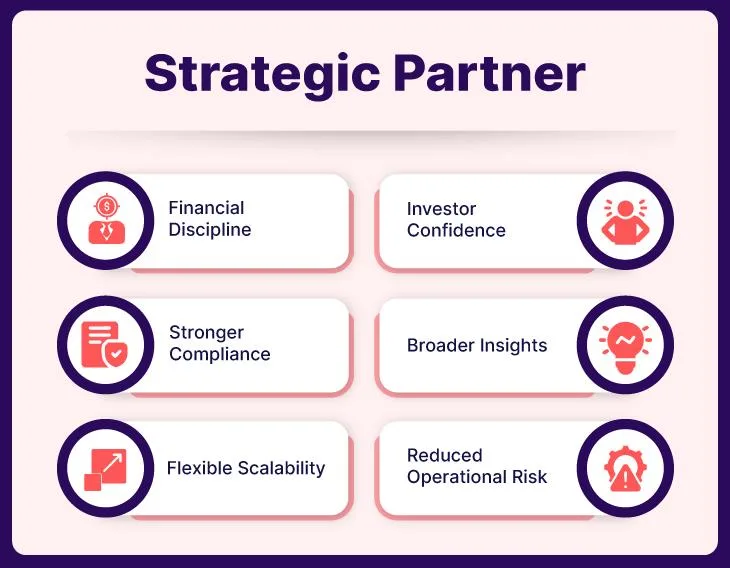
Here are the additional strategic gains:
1. Strengthened Financial Discipline from Day One
Startups often struggle with inconsistent processes, undocumented workflows, and fragmented records. Outsourced accounting introduces structure. This includes monthly closures, standardized reporting, internal controls, and proper documentation. All this enables founders to build financial discipline that supports long-term stability.
2. Better Investor Confidence and Fundraising Readiness
Investors expect clean books, clear metrics, and credible financial models. A specialized outsourced accounting firm ensures the company is always ready with accurate reports, real-time dashboards, burn analysis, and GAAP-aligned statements. This builds credibility and can improve valuation conversations.
3. Stronger Compliance and Lower Regulatory Risk
Startups have to navigate tax rules, payroll laws, sales tax nexus, and state-specific reporting requirements. Outsourced teams stay updated on regulatory changes and ensure your filings meet federal and state requirements. Thus, reducing legal exposure and protecting the company from compliance surprises.
4. Access to Broader Insight
Instead of relying on a single in-house hire with limited experience, outsourcing gives startups access to:
Bookkeepers
Payroll specialists
Controllers
Analysts
CFO-level advisors
This breadth of experience helps founders navigate complex questions around pricing strategy, forecasting, costs, hiring plans, and expansion timing.
5. Seamless Scalability as the Startup Grows
As the startup expands, financial needs become more complex. Cash flow modeling, multi-state compliance, financial controls, and investor reporting all attributing their share. Outsourced accounting scales instantly without requiring new hires or internal restructuring.
6. Reduced Operational Risk Through Built-In Controls
Outsourced firms operate with checks, audits, review layers, and role-based security. This significantly lowers the chances of fraud, data mishandling, or financial misstatements, issues that can derail young companies.
7. A Partner Who Provides Perspective, Not Just Processing
Startups benefit from objective, third-party financial insight. A strong outsourcing partner helps founders think strategically, solve financial challenges early, and respond with clarity in uncertain situations.
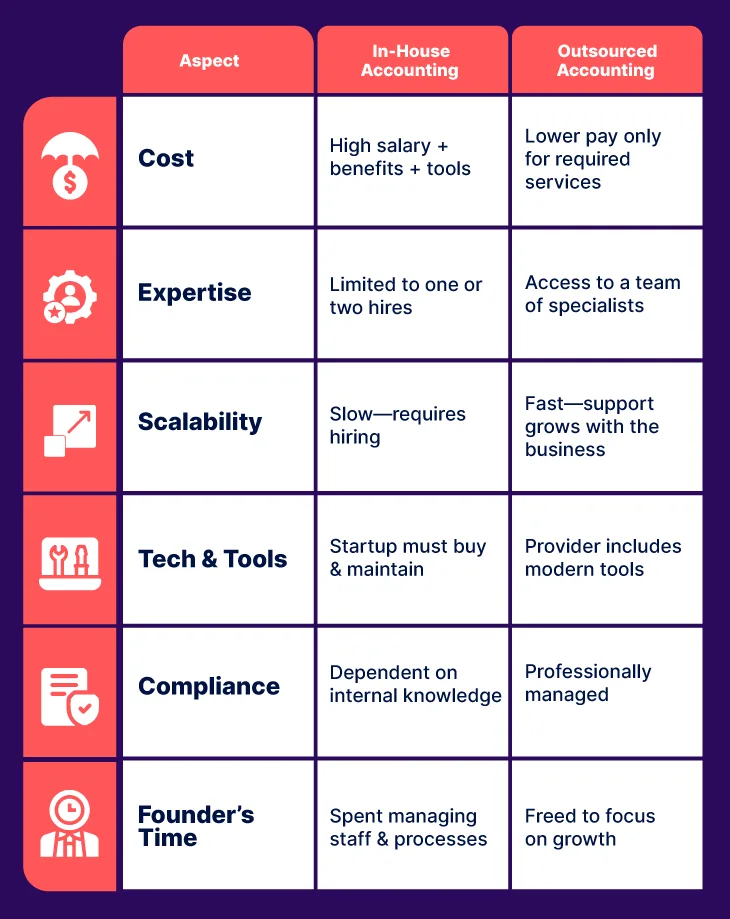
Below is a simple comparison to help startups make a firm and more informed decision:
This is why many founders today prefer outsourced accounting services for startups, especially in the U.S. where quality talent is expensive, competition is skyrocketing and customer expectations are ever-evolving.
Why Working With the Right Partner Matters
Outsourcing accounting is more than a cost-saving move. It’s a strategic decision that shapes how a startup grows. The right provider brings structure, accuracy, technology, and financial clarity, helping founders make better decisions and operate with confidence.
However, outsourcing only works well when the partner understands the U.S. startup ecosystem, investor expectations, compliance requirements, and the pace at which early-stage companies move.
As a strategic and reliable outsourcing partner, QX offers U.S. startups flexible accounting support, pre-trained teams, strong quality controls, secure processes, and scalable solutions that grow with your business. Startups gain the financial infrastructure they need, without the cost or complexity of building an internal finance team.
If your startup is scaling quickly and needs a smarter way to manage finance, reach out to us today.
FAQs
1. Do startups in the U.S. commonly outsource their accounting and finance functions?
Yes. Many U.S. startups now rely on an outsourced accounting firm for startups to access skilled professionals at lower costs while staying compliant with GAAP and IRS rules. This trend continues to grow as founders look for the best outsourced accounting firms for startups that can support them end-to-end.
2. How much money can a startup actually save by outsourcing accounting?
Outsourcing often reduces finance costs by 40–60%, making US outsourced accounting services for startups far more cost-efficient than building an in-house team. You only pay for what you need, making it one of the smartest financial decisions for early-stage companies.
3. What financial tasks do most early-stage startups outsource first?
Most founders begin with core tasks such as bookkeeping, payroll, AP/AR, monthly closes, and tax preparation. As they scale, many expand into outsourced finance and accounting for startups, including budgeting, cash-flow forecasting, and fractional CFO support.
4. How do I ensure the outsourced provider understands U.S. compliance and tax regulations?
Choose a partner with deep U.S. startup experience, strong internal controls, and teams trained in federal and state compliance. Most outsourced accounting firms for startups will provide sample reports, process documentation, and clarity on how they maintain accuracy and regulatory compliance.
5. What should founders look for when evaluating outsourcing partners?
Evaluate expertise, communication, pricing transparency, scalability, and technology stack. The best outsourced accounting firms for startups combine automation, advisory support, and compliance discipline to guide founders from seed stage to growth stage without financial bottlenecks.
Vishal Shah
With 13 years of experience in accounting and bookkeeping, Vishal Shah leads QX’s accounting operations, managing a 65+ member team. He specializes in process efficiency, quality control, and client delivery across industries, including SaaS, real estate, and workforce management. Vishal’s leadership drives scale, speed, and client satisfaction for CPA firms.
Unauthorized copying or plagiarism of our content is a violation of intellectual property rights. We take such matters seriously and will pursue legal action to protect our original work. Anyone found engaging in such activities will be held accountable under applicable laws.
Don't forget to share this post!
Our Latest Insights
Explore all insights on topics that matter to you and your accounting firm.










 Book a Virtual Meeting
  Get Your ROI Estimate