Why Automating 1040s Matters More Today Than Before



Summary:
Tax season pressure is rising as firms handle more 1040 returns with fewer people and tighter deadlines. This blog explains why manual tax preparation no longer scales, how 1040 automation reduces reactive work, improves accuracy, shortens review cycles, and helps firms regain control of capacity. It also shows how automation has become a competitive advantage, enabling healthier teams, predictable delivery, and sustainable growth during busy season.
Tax season looks the same every year on the surface
Deadlines. Long hours. Heavy review loads. But what has changed is the pressure underneath.
Firms are handling more returns with fewer people. Client expectations are higher, and review time is becoming increasingly shorter. At the same time, talent shortages and burnout are becoming the norm. This is why automating 1040 tax preparation is no longer optional. It has become a requirement for firms that want to stay efficient, profitable, and competitive.
This article explains what 1040 automation really means, why it matters more today than before, how it improves outcomes, and why solutions like ROBO1040 are changing how firms approach tax season.
What Tax Automation Really Means
Automation primarily appears to be a concept that replaces professionals. But in reality, it’s just the opposite of that. Tax Automation is about enabling professionals to do higher-value tasks by removing repetitive, low-value work from the process.
In a 1040 workflow, this includes:
- Data extraction from source documents
- Standard calculations and validations
- Form population and consistency checks
- Basic review prep and error flagging
Automation ensures these steps happen faster and more accurately. Accountants remain in control of judgment, review, and client communication to ensure it remains human.
You see, the goal is simple. Less manual effort. Better outcomes.
The Manual Tax Preparation Trap
Many firms stay manual longer than they should. At first, it feels manageable. Returns get done, and teams push through. But over time, problems surface.
- Review cycles slow down.
- Errors increase.
- Senior staff spend time fixing avoidable issues.
- Teams work longer hours just to keep pace.
Typically, firms respond by hiring additional personnel, extending timelines, or accepting lower margins. To tell you the truth: none of these scale well.
What comes to the rescue is AI. Automation breaks this cycle. It removes friction from the workflow. It restores control over capacity, quality, and turnaround, without burning out teams.
Why Automating 1040 Taxes Is More Crucial Than Ever
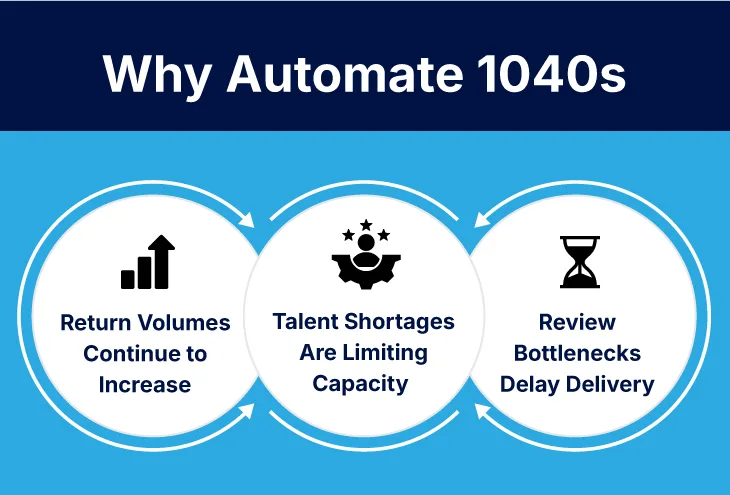
1. Return Volumes Continue to Increase
Firms are processing an increasing number of individual returns each year. This growth is not matched by staffing levels. This is why manual workflows break under volume pressure.
Automation enables firms to handle higher volumes without overextending their teams. Work moves faster and stays consistent.
2. Talent Shortages Are Limiting Capacity
Experienced preparers and reviewers are harder to find. Hiring during peak season is even slower and more expensive due to the high demand and rising competition.
Automation reduces dependency on manual prep. Thus, helping firms get more output from existing teams.
3. Review Bottlenecks Delay Delivery
Reviews often become the slowest part of the workflow. Sometimes, errors discovered late create rework and delays. Automation flags these issues early, ensuring returns reach reviewers in better shape. This shortens review cycles and keeps the entire process in check.

ROBO1040 – Your Tax Buddy
Transform Tax Efficiency by up to 40%. Want to see this in action?
Book a demo today!
Click here!How 1040 Automation Improves Outcomes
1040 automation enhances outcomes by eliminating the reactive work that consumes the majority of tax teams’ time today. According to Thomson Reuters, tax professionals spend 56% of their time on reactive tasks, even though they want to spend less than half of that. Making automation essential for reducing burnout, improving accuracy, and creating space for higher-value review and advisory work.
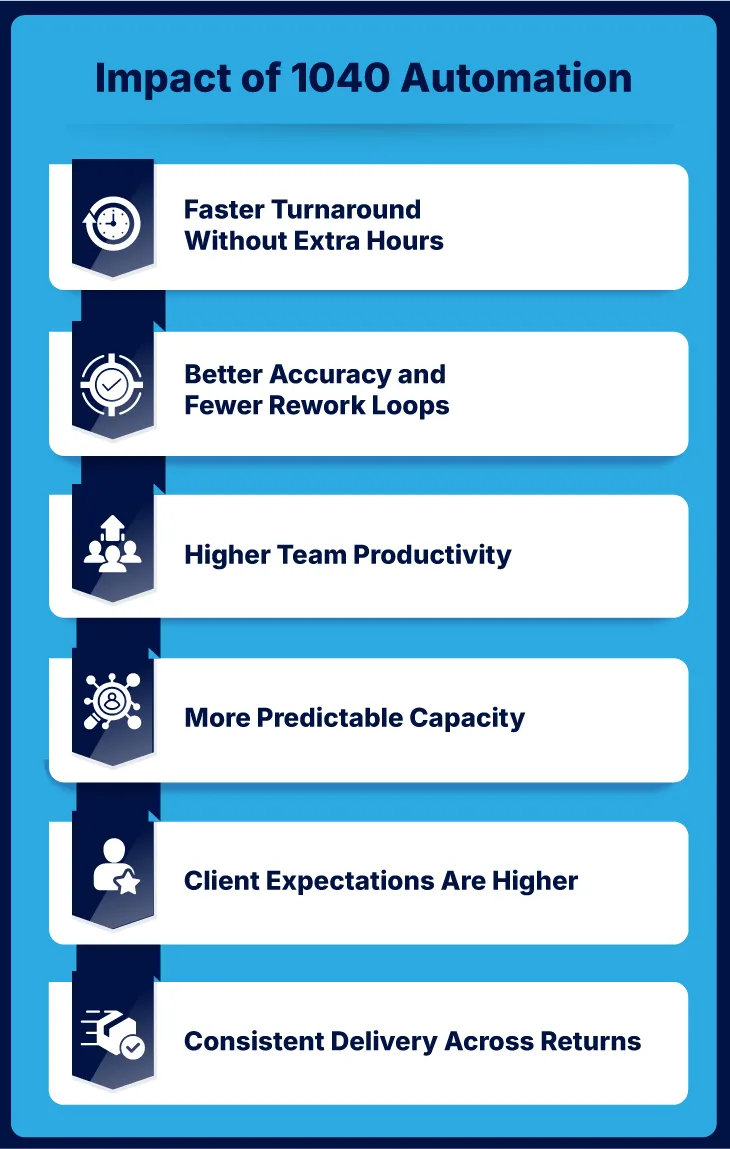
1. Faster Turnaround Without Extra Hours
Automation reduces preparation time by standardizing workflows and eliminating repetitive steps. Returns move through the system consistently, without relying on overtime or last-minute pushes.
2. Better Accuracy and Fewer Rework Loops
Automated checks catch inconsistencies early. Reviewers spend less time correcting basic issues and more time applying professional judgment.
3. Higher Team Productivity
When routine work is automated, experienced staff can handle more returns without increasing workload. This improves output without increasing stress.
4. More Predictable Capacity
Firms gain clarity on how much work they can handle. Planning becomes easier, and deadlines feel manageable instead of chaotic.
5. Client Expectations Are Higher
Clients expect a faster turnaround while maintaining accuracy. Automation helps firms meet both. It improves speed without compromising quality.
6. Consistent Delivery Across Returns
Automation enforces process discipline across teams. Tools like ROBO1040 ensure every return follows the same controlled workflow, improving turnaround time and consistency during the busy season.
The Bigger Picture: Automation as a Competitive Advantage
Automation is no longer just about efficiency during tax season.
It is changing how firms compete.
Firms that rely on manual 1040 preparation often operate reactively. They adjust staffing late and extend review cycles. Over time, this limits growth and puts pressure on margins.
Automation shifts firms from a reactive to a deliberate approach.
With automated 1040 workflows, capacity becomes predictable. Firms know how much work they can handle without stretching teams or compromising quality. This predictability improves planning, both for peak season and year-round operations.
Automation also changes how talent is used. Instead of spending hours on data entry and corrections, professionals focus on review, judgment, and client conversations. This improves job satisfaction and reduces burnout.
From a financial standpoint, automation protects profitability. Manual processes scale linearly. More returns mean more hours. Automation breaks that link. Firms increase volume without matching cost increases.
Over time, the advantage compounds. Firms with automated workflows deliver consistently, retain staff more easily, and operate with fewer surprises. This stability enables leadership to focus on growth and strategy, not seasonal damage control.
ROBO1040 by QX: Built for Modern 1040 Delivery
ROBO1040 is designed specifically for high-volume 1040 preparation.
It combines automation, structured workflows, and review controls to help firms handle peak season demands without chaos. Returns move faster. Errors drop. Teams stay focused on high-value work.
ROBO1040 integrates into existing tax processes rather than forcing firms to rebuild everything. This makes adoption practical, even for firms already deep into busy season planning.
Conclusion
Automating 1040 preparation is no longer about staying ahead.
It is about staying viable.
Manual processes create bottlenecks, burnout, and risk. Automation introduces structure, predictability, and scalability. Firms that adopt it are better prepared for peak season and better positioned for long-term growth.
Platforms like ROBO1040 by QX help firms move beyond survival mode and into sustainable delivery. The result is faster returns, healthier teams, and a stronger operating model.
FAQs
1. What does 1040 tax automation actually replace in the workflow?
1040 automation replaces repetitive, rules-based steps such as data extraction, standard calculations, form population, and basic validations. Review, judgment, and client communication remain fully human-led.
2. Will automating 1040s reduce the need for experienced tax staff?
No. Automation reduces low-value manual work, not professional expertise. Experienced staff spend less time fixing preventable issues and more time on review, judgment, and complex tax scenarios.
3. How does 1040 automation help with review bottlenecks?
Automation flags common errors early in the process. Returns reach reviewers in better shape, which shortens review cycles and reduces back-and-forth rework during peak season.
4. Is 1040 automation only useful for large firms?
Not at all. Mid-sized and growing firms often benefit the most because automation helps them handle higher volumes without adding headcount or relying on extended overtime.
5. How quickly can a firm see results after adopting 1040 automation?
Most firms experience improvements within the first tax season, including faster turnaround times, fewer rework loops, and more predictable capacity, especially during peak weeks.

Gaurav Bhansali
Gaurav Bhansali is the VP of US Operations at QXAS and in his current role, he partners with firms to transform how tax and accounting services are delivered. He’s a licensed US CPA and EA with prior experience at EY, and he focuses on automation, process improvement, and AI-led solutions that make outsourcing smarter and more effective.
Unauthorized copying or plagiarism of our content is a violation of intellectual property rights. We take such matters seriously and will pursue legal action to protect our original work. Anyone found engaging in such activities will be held accountable under applicable laws.
Don't forget to share this post!
Our Latest Insights




Let’s Work Together
Explore outsourcing solutions, request a free trial or discuss your practice’s needs with our expert consultants.
 Book a Virtual Meeting
  Get Your ROI Estimate