Benefits of Outsourcing Payroll in 2026: For CPA Firms



Summary:
Payroll has become more than just a routine back-office job. It is now a major part of compliance, accuracy, and building employee trust. As regulations become stricter and payroll tasks get more complicated, many companies are rethinking whether to keep payroll in-house. This guide explains the advantages of outsourcing payroll and how it can cut down on errors, improve payroll tax compliance, and boost data security. So that your team can focus on work that is important for the business.
Outsourcing payroll was once seen as a convenience play. But not anymore. Payroll compliance requirements are tightening, and the demand for accuracy is increasing multi-fold. This is putting traditional in-house payroll models under pressure like never before.
Firms are expected to deliver error-free wage calculations, ensure timely tax filings, and stay aligned with evolving federal and state tax regulations (USA), often with lean internal teams.
This shift is also supported by the market momentum. The global payroll outsourcing market is projected to reach $12.1 billion by 2028, up from $8.9 billion in 2022. The growth is being driven by regulatory complexity, automation adoption, and the need for scalable operating structures.
Payroll looks transactional on the upper layer, but what about its core?
Talking about the very basics, payroll functions is an amalgamation of compliance, finance, HR, and most importantly, employee experience. Any error in this department impacts the brand image and the trust built over years of hard work. Monetarily, also, any delay triggers heavy penalties.
If you want to read about Outsourcing payroll in depth (How it works, costs and more); here’s a blog suggestion for you.
Click Here!
As payroll becomes increasingly people-focused and heavily governed by compliance, manual processes are becoming cumbersome. One that consistently drains leadership bandwidth. The benefits of outsourcing payroll are no longer limited to convenience. Firms now view payroll outsourcing as a way to reduce operational risk, improve accuracy and free internal teams from repetitive HR administration. This empowers leaders to stay focused on higher-value priorities.
Is It Better to Outsource Payroll?
No doubt, In-house payroll offers direct control to the firms, but that control comes at a cost. The costs of growing operational overhead, complex operating structure, and mental stress. Internal teams are responsible for end-to-end wage calculations, payroll tax compliance, and staying current with federal and state tax regulations (USA).
As payroll complexity grows, multi-state filings, benefits deductions, regulatory updates, and exception handling become more challenging. Manual processes and fragmented systems increase the risk of payroll errors and late tax filings. This often consumes HR resources, raises compliance risks, and leads to recurring rework.
To manage all this, firms are now significantly relying on outsourcing payroll.
Outsourcing payroll replaces existing traditional processes with a standardized, technology-driven solution. Providers use payroll systems that improve accuracy, enforce validation checks, and strengthen compliance. Thus, enabling firms to save time on HR administration.
Beyond operational efficiency, outsourcing also improves the employee experience; 57% of companies report increased employee satisfaction after outsourcing payroll. This is driven by fewer payroll errors, more consistent pay cycles, and faster issue resolution.
For many firms, this makes outsourced payroll a strategic operating model decision. This is not just influenced by cost but by various other factors, which we will be covering in the next section.
Case Study
A leading CPA firm in Hawaii needed to scale its EBP audit and nonprofit tax services without increasing headcount, investing significantly in training, or losing control and visibility over its processes. The firm sought a partner able to integrate with its audit methodology, workpaper standards, and tax protocols.
Enter QX, the firm’s ideal strategic ally. QX’s team quickly adapted to the firm’s SOPs and software, requiring minimal training, resulting in significant time savings. Within 12 months, the firm achieved significant results.
The impact:
- $290K in annual cost savings
- Offshore capacity scaled from 6 to 19 FTEs
- Stronger delivery continuity across EBP audits and nonprofit/exempt filings
- Improved turnaround during peak periods without compromising review rigor
This case shows that a process-integrated, compliance-focused outsourcing model can increase delivery capacity in regulated audit and tax environments while maintaining quality and client trust.
Still Managing Payroll In-House? It’s time to switch to the new way! Explore QX Payroll Delivery Model.
Connect with us today!headphones
What are the main benefits of payroll outsourcing?
What Payroll outsourcing delivers goes far beyond operational relief. The benefits span cost efficiency, accuracy, compliance, security, and scalability; addressing both day-to-day challenges and longer-term operating constraints. The following points show the most tangible impact.
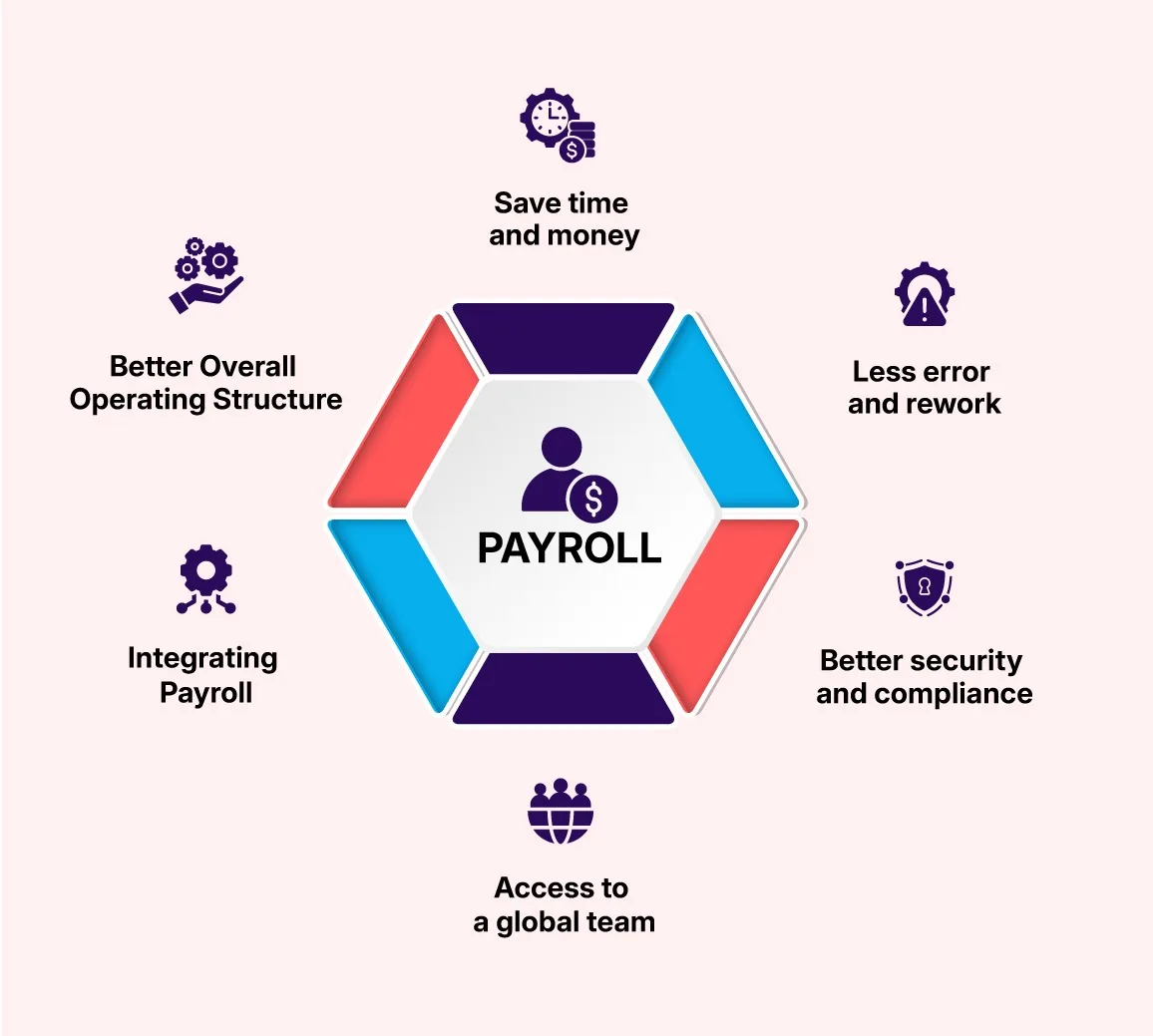
Time Saving & Money
Outsourcing payroll reduces time spent on HR administration and is more cost-effective than maintaining in-house systems, training, and compliance management. Small businesses that outsource payroll see a 30% reduction in payroll administration costs, making the in-house vs. outsourced payroll decision a potent financial decision.
Reducing Error and Rework
Outsourcing replaces manual payroll processing with process-led workflows. This improves wage calculation accuracy, flags inconsistencies early, and materially lowers the risk of recurring payroll errors. Thus, significantly reducing errors and eventually, rework.
Ensuring Better Data Security and Compliance
Leading providers invest in data security in payroll, including payroll encryption, access controls, and secure infrastructure to protect employee-sensitive information. Outsourcing also strengthens payroll tax compliance and supports adherence to federal and state tax regulations while helping firms avoid payroll penalties.
Access to a Global Team
Outsourcing enables access to specialized payroll professionals across geographies, giving firms coverage across time zones and regulatory environments. This global delivery model improves continuity, scalability, and turnaround times without requiring internal hiring for each new compliance context.
Integrating Payroll
Modern providers support benefits integration across 401(k), health insurance, and other programs, along with payroll and HR software sync. This reduces manual data handoffs and improves reporting accuracy across HR, finance, and benefits platforms.
Better Overall Operating Structure
Outsourcing 3.0 shifts payroll from a transactional task to an integrated operating model linked with accounting, compliance, and HR workflows. This improves governance, auditability, and scalability while preserving operational control.
When Should a Company Consider Outsourcing Payroll?
Outsourcing payroll becomes a strategic decision when operational friction starts showing up as errors, delays, or compliance risks. If internal teams are spending disproportionate time on payroll administration, struggling to keep pace with changing federal and state tax regulations, or dealing with recurring corrections, the in-house model is likely creating hidden costs.
Firms should also evaluate outsourcing when payroll complexity increases. This includes multi-state payroll, growing headcount, or expanded benefits programs that require tighter benefits integration and payroll and HR software sync. This is where outsourcing payroll stabilizes the situation. It helps in seamless execution, strengthens payroll tax compliance, and ensures timely tax filings, without adding internal overhead.
Conclusion:
The foundations of payroll are shifting. They are growing, transforming, and evolving with new development every day.
It is no longer just about maintaining the payslips or a positive employee experience. Payroll has become a compliance-critical function, where accuracy, timeliness, and data security directly affect many factors. The most important ones being business risk and employee trust.
As regulatory demands increase and manual processes continue to strain internal teams, the limitations of in-house payroll become harder to justify. The benefits of outsourcing payroll make outsourcing a strategic operating model choice.
With over two decades of experience supporting accounting and tax operations, QX Accounting Services helps firms modernize payroll delivery through secure, compliance-led, global delivery models. One that can be scaled up or down according to demand and business requirements.
If payroll is draining your leadership focus or causing compliance headaches, it is time to move past temporary solutions. Discover how QX can help you create a scalable, confident payroll model that keeps things simple. Let us connect and discuss further.
FAQs
What are the primary benefits of outsourcing payroll for small businesses?
For small businesses, the primary benefits of outsourcing payroll include reduced payroll errors, stronger payroll tax compliance, and significant time savings on HR administration. Outsourcing also improves cost predictability by enabling cost-effective payroll processing and providing access to automated payroll systems without the need to build in-house expertise.
How does outsourcing payroll improve compliance?
Outsourcing payroll improves compliance by embedding regulatory requirements into payroll workflows. Providers ensure alignment with federal and state tax regulations, manage withholdings and filings, and enable timely tax filings, helping businesses avoid compliance gaps and payroll penalties.
Is it more cost-effective to handle payroll in-house or outsource it?
In most cases, outsourcing payroll is more cost-effective. When comparing in-house vs. outsourced payroll, outsourcing reduces overhead associated with payroll software, training, rework, and compliance management, making the cost-effectiveness of outsourcing payroll more sustainable as payroll complexity grows.
How do payroll outsourcing companies protect my data?
Payroll outsourcing companies invest in data security in payroll, including payroll encryption, access controls, secure infrastructure, and audit trails to protect employee-sensitive information. These controls are often more robust than what small and mid-sized firms can maintain internally.
Can I integrate my benefits program with outsourced payroll?
Yes. Most payroll outsourcing providers support benefits integration for programs such as 401(k) and health insurance, along with payroll and HR software sync, ensuring payroll, benefits, and HR data remain aligned and reducing manual reconciliation.

Sunil Gajjar
CA Sunil Gajjar is a seasoned Chartered Accountant with over 13 years of experience, including more than a decade in US accounting and bookkeeping. As Manager of Operations at QX Global Group, he leads a 60-member team focused on client satisfaction, staff development, and process excellence. His expertise spans Indian and Australian taxation, financial reporting, and audit compliance. Sunil’s leadership combines strategic thinking with a people-first approach, helping teams deliver consistent value and performance across CPA firms and global operations.
Unauthorized copying or plagiarism of our content is a violation of intellectual property rights. We take such matters seriously and will pursue legal action to protect our original work. Anyone found engaging in such activities will be held accountable under applicable laws.
Don't forget to share this post!
Our Latest Insights



Let’s Work Together
Explore outsourcing solutions, request a free trial or discuss your practice’s needs with our expert consultants.
 Book a Virtual Meeting
  Get Your ROI Estimate